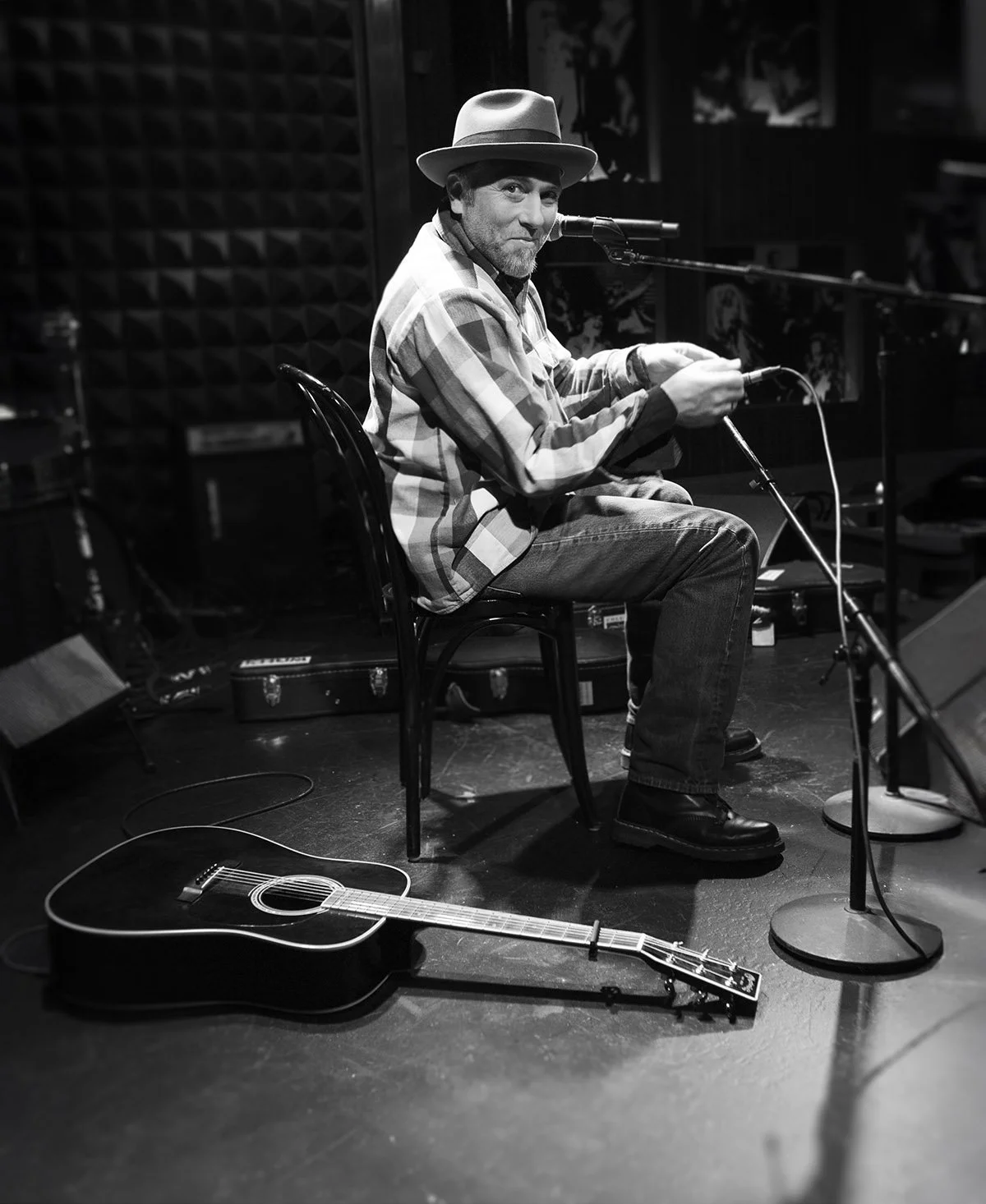

Kelly Joe Phelps (1959–2022)
Harlan Howard once said country music is “three chords and the truth.” Bono echoed the line years later during U2’s live performance of All Along the Watchtower. But few ever lived that phrase like Kelly Joe Phelps.
Kelly could take three chords and push and pull them through conviction, love, loss, and longing… bending notes so close to the breaking point they felt etched into the music like the folded layers of a katana blade, sharp enough to split a ghost.
He didn’t just find the notes between the notes—he introduced you to them personally, the way a great wine resurrects a forgotten memory.
I tattooed Kelly in 2009 and traded my fee for a private show at my shop. He was on tour supporting his girlfriend’s album then—playing from the back seat, holding himself in reserve—so the room only heard the shadow of what he carried.
What none of my sixty guests experienced was his soundcheck.
Kelly drifted through fragments… sounds without songs, unmoored notes, words drawn from his soul—listening to the room, chasing balance, finding dead spots… But when he started playing, something ancient filled the air.
A spirit older than the guitar, older than the walls around us.
A feeling born from sorrow, steeped in longing, baptized in lost chances.
If it had a name, it was the Blues.
Kelly Joe was Blues, through and through. He asked me for flowers on his forearm opposite the other that read “59 Musician.”
“I was born in ’59,” he said.
I asked how many guitars he had.
“Twelve now. I had forty-four. Been sellin’ ’em.”
“Why?”
“I need the money.”
He was the finest musician I’ve ever seen—better than anyone I’ve watched collecting Grammys from a stage he’d never stand on.
“Why aren’t you up there?” I asked.
“I’ve been told I’m unmanageable.”
When Martin offered him a signature guitar, he turned it down.
“The D-28 is already perfect,” he said. “There’s no point.”
Three chords and the truth.
Kelly Joe Phelps lived them—and left them resonating.