
Meet Federica and Simone
Interview by Jeff Gogué
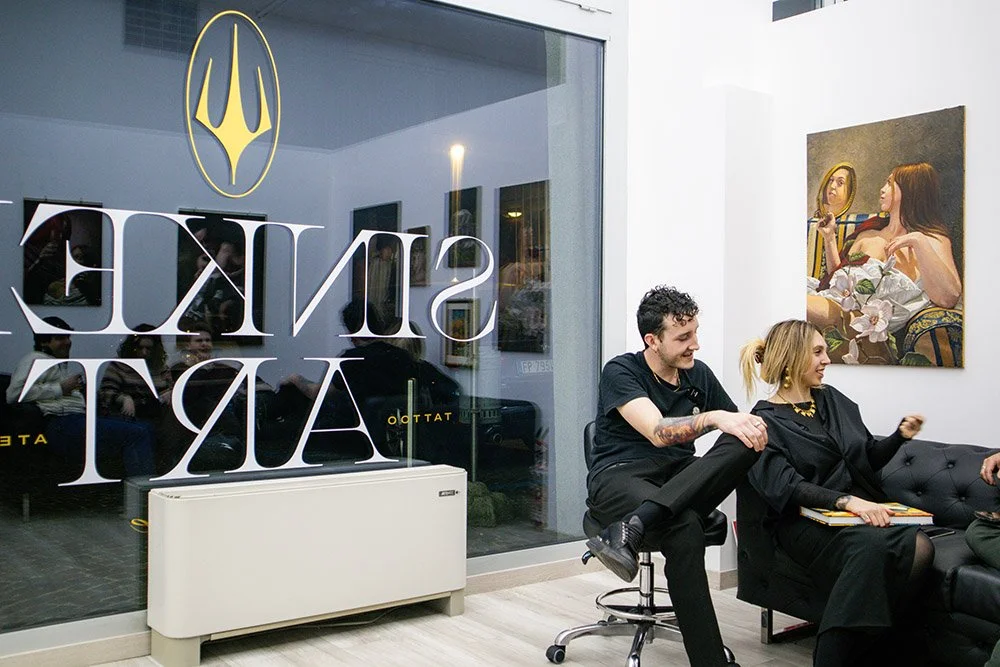
@sinkedartpordenone
@simonecovallero_tattoo
@federicaorlandotattoo
@allesandrocovallerotattoo
sinkedart.com

The Studio was born out of a passion for tattooing and a desire to create a new tattoo studio concept!
Sinked Art, ‘Submerged Art,’ brings us back to the marine world, of eternal works that lie under the sea but continue to have their own history and beauty. And that is how we want to shorten the distance between Art and Tattooing.
The Atelier offers spaces for display and discussion between Artists of all kinds and clients, who would like to immerse themselves in our world.
Taking the train from Venice to Pordenone, Italy, was a thrill ride. As we left behind the labyrinth of alleys in Venice, we enjoyed the caffeine-fueled conversation as the scenery transitioned into the verdant plains of Veneto, where vineyards stretch as far as the eye can see. The anticipation was palpable as we ventured forth to meet these young tattooers, whom we had met briefly a few months before. After that first conversation, we knew there was something special about these two, and we couldn’t wait to come back.
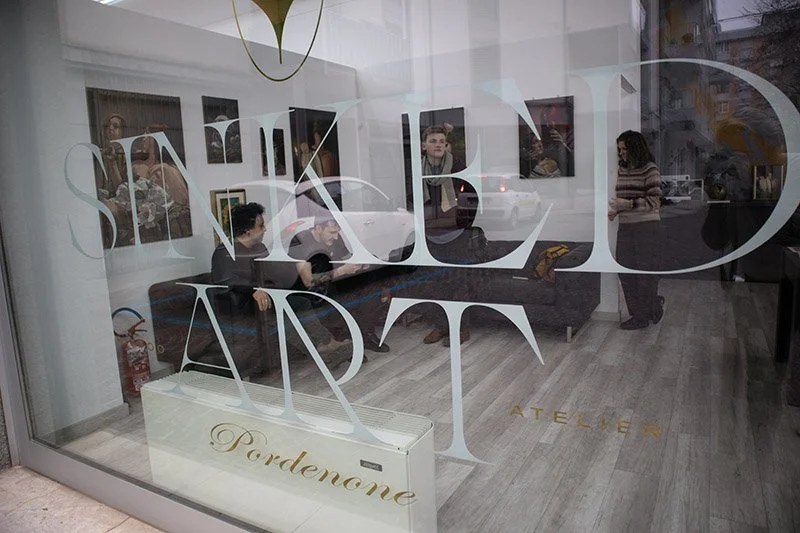
Their studio is brand new, modern, and bright. It has white walls and minimalist decor—quite the contrast after being immersed in the extraordinarily embellished Venice for three days leading up to this visit. The lighting installation itself was impressive: a full ceiling grid of the same lights used in car showrooms, designed for even light distribution without any cast shadows.
We were greeted warmly by Simone, his brother Alessandro, and Federica, along with their guest artist and clients.
Being surrounded by a body of work, sophisticated style, good looks and charisma had us feeling like we had just walked into the Cullen House. Were these people twenty three or two hundred and twenty three?
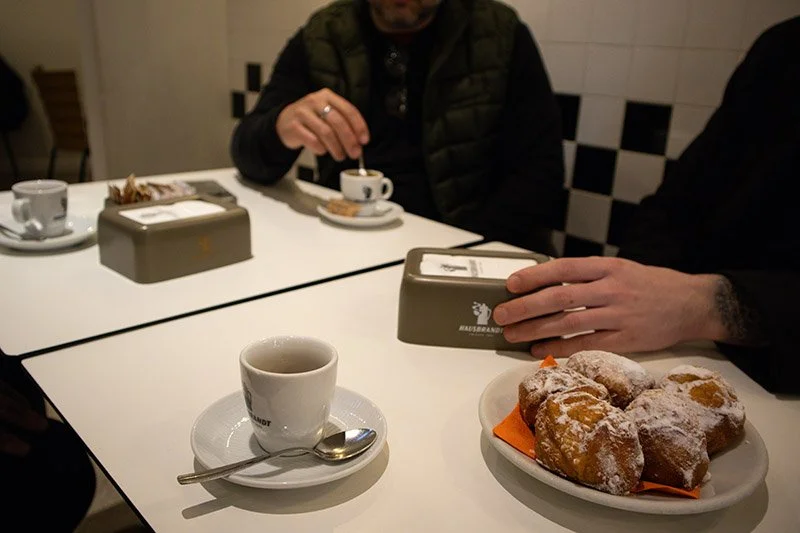
We were fortunate enough to visit during the Fritelle season. Simone whisked us away to their local Cafe for Machiatto and Fritelle cream, which was absolutely the best pastry I’ve ever eaten— and I’ve had a lot of pastry.
As Jeff settled on the couch with phone on record, I couldn’t help but feel the special quality of this place in time. Amidst Italy’s ancient history and artistic wonders, yet surrounded by these fresh-faced talents, each with their own brushstroke on the canvas of tradition. It was a collision of worlds, old and new, with creativity as the common language.
— Laura Jade
Jeff Gogué: It’s great to visit with you two again. We had such a memorable discussion last May. I’m really happy to be doing this with you both and to see your beautiful new shop. It’s both of you and Simone’s brother, Allesandro, who is also an incredible tattoo artist, in this together. The quality of work being done here is outstanding. When we first walked in, it was such a thrill to be shown so much good artwork right away. We watched you fill this table with sketch after sketch and amazing paintings. It is so nice to see so much dedication happening here. We are all blown away.
So... I’d like to start this discussion with the words “inspiration” and “information”—to inspire and to inform. With our 40-year combined tattoo experience, Laura and I have seen so much information, especially these days, online, social media, podcasts, and seminars—so much informing. Information is everywhere. It’s all telling and showing how and what to do. And we do take things, adhere to them, take information, and take inspiration.
Our focus is not so much to inform but to inspire. We want to give some inspiration... we want to gift inspiration.
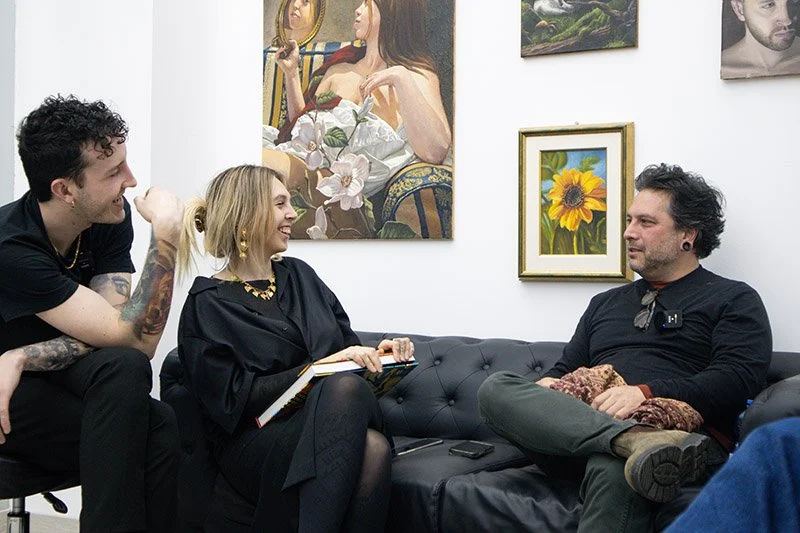
Simone: I think the same; sometimes people ask me why I don’t do seminars or something like that. For us, it’s too early. I know some techniques, but we have only been in the tattoo industry for 3-4 years. Even recently, in Milan at the convention, I felt like the last part of the train… because we are the youngest. We still have to take inspiration… and maybe someone should choose who can give out all of this information. So many artists are doing seminars that just last 1 hour and explain only how to do something... but they don’t give you something more.
JG: There is so much focus on how to do things. So today, I don’t need to know how you do your tattoos; you are both very talented and have worked so hard to be where you are. I don’t need to understand what kind of needles and ink you use, but I’d love to talk to you about tattooing. When we first met last May, you were working at Alex De Pase’s studio in Venice, the Venetian Job. We visited because I’ve been friends and business partners with Alex, and it was such a nice surprise to meet you both there. I was so impressed with your genuine personality, intelligence, and unreal talent. We had such a good conversation that day, so we wanted to come back to Italy and include you in Olinjär.
You have both graduated from Alex De Pase’s three-year tattoo academy. It is amazing to be here and see all of these thumbnail sketches, anatomy drawings, master copies, and paintings. I’m so impressed by your commitment to art. You have dedicated so much time to study and practice and clearly have a deep respect for your work. The training you’ve gone through is unbelievable. Do you feel proud? Historically, Italians especially, but I want to know what you think… would you say Italian men are very proud?
Simone: Yeah, yeah.
JG: They’re very “I can do that”... “I’m better than that”...” I’ll win.” They have big ideas…so I think of Italian confidence as male…
Simone: Yep.
JG: Male Italians want to conquer the world.
Simone: Of course.
JG: Is that female also? Is Italian confidence in females?
Federica: No. During the years I have worked as a tattoo artist, it was more difficult for me than Simone because I’m a girl. Also, getting to know other tattooers is difficult for me because I’m a girl. Maybe your girlfriend is jealous or something… I’m not that type of person… But I can’t come up to everyone and say I admire your work because maybe your girlfriend doesn’t like it. For me, it was more difficult.
JG: Do you have the desire? For competition? To be better?
Federica: Of course. I am a competitive person.
Simone: And on the other end, I see from the outside that she’s not really that self-confident. Before Milan… she says she won’t participate in any contests because she thinks she is not good enough for Milan.
Federica: For me, I am just four years in… I may have too much humility. Perhaps it’s a different word. Insecurity…
JG: Humility would be understanding where you are, knowing you’re young and new. Insecurity would be nervous that you’re not good. So, do you feel more humility or insecurity?
Federica: Maybe both.
JG: What is more powerful?
Federica: I think insecurity.
JG: So with time… in time and practice and more understanding and more skill, then we trade insecurity for humility.
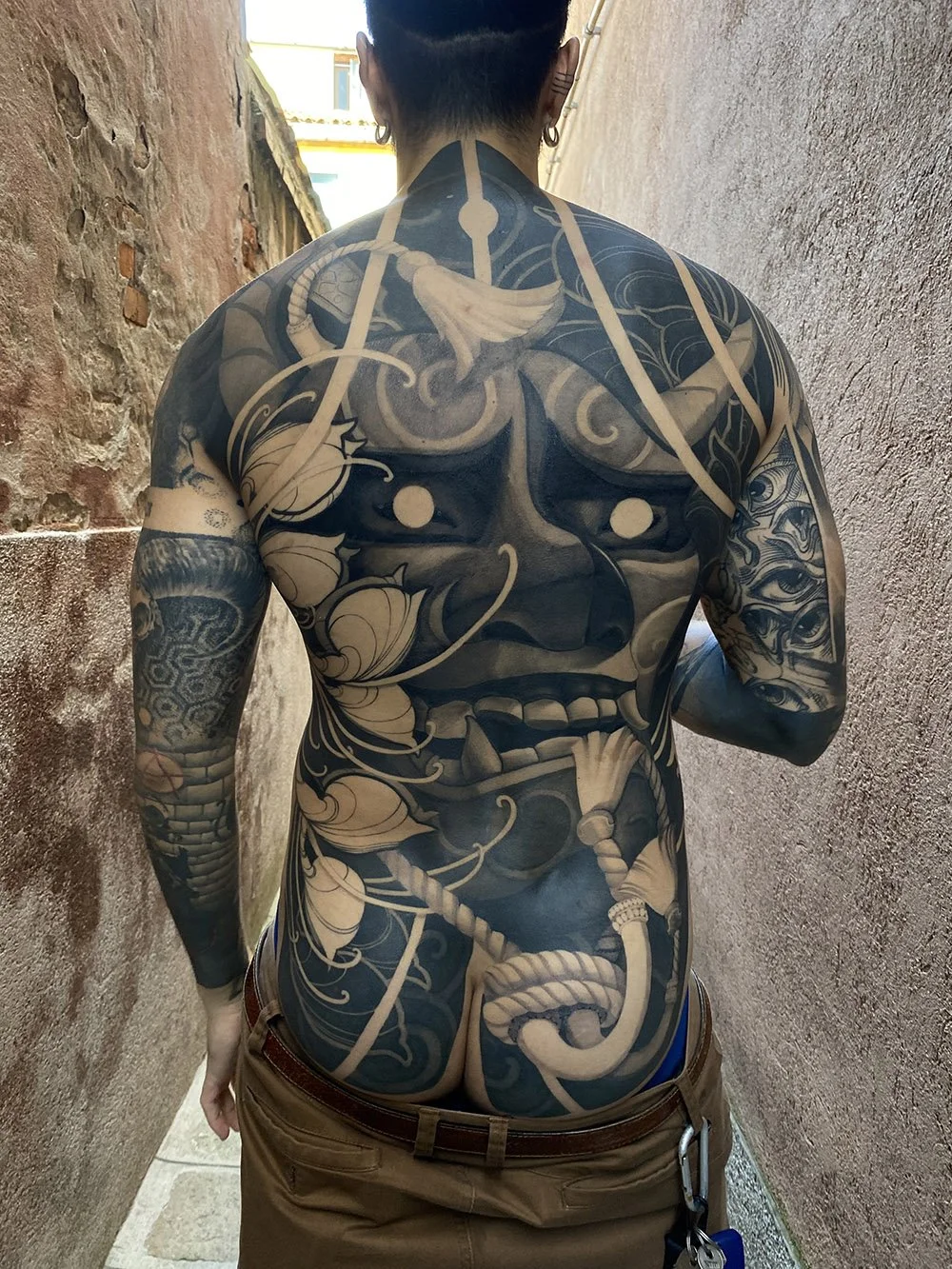
Simone: There was a tattooer in Milan; she really admired him for his tattoos. He went to her and filmed her Hannya back-piece and told her, “Amazing, oh wow…insane,” and she was like, I don’t deserve it… so I see the insecurity is there.
JG: That’s normal… it’s all good. And I saw on Instagram that the back-piece won 2nd place best Japanese in Milan. That’s amazing. Congratulations!
So, when did you start thinking about tattoos? When did you start wanting to tattoo? Why did you believe that you could be a tattooer?
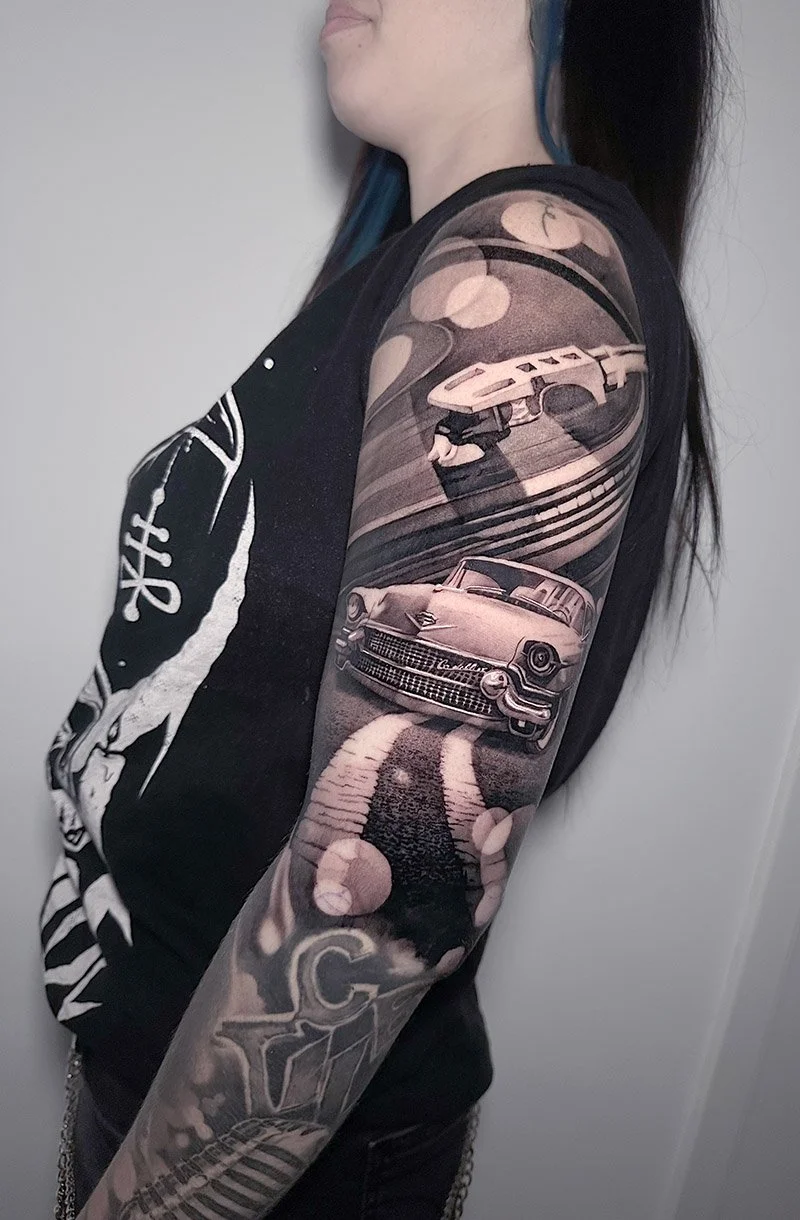
Simone: The first tattoos I ever saw were on my Dad; when we were 18 years old, he was a little bit crazy guy, so in Italy, you are obliged to go into the military… and he was a little bit rebellious, and when he was there he got tattooed… some symbols and a rose so when I was younger I always saw them. Just one needle dipped in ink, so that story was always in my mind. Also, I was 12 when Miami Ink was on. In Italy, you have to choose which future you want early. Artistic study or Science, for example…starts as early as high school. I decided to do scientific high school, but I think it was too early to determine. But Scientific studies would prepare you for many things, so I chose that. Then, randomly, after school, there was a flyer for Alex’s academy… and I was always drawing while my teachers were teaching… all the time drawing. I could hear them talk still at the same time, but the drawing felt like an expression. My brother started tattooing before, and I really wanted to trust him, so I gave him my leg for his first piece. He was in the academy 2 years before me. When my high school ended, I didn’t like it anymore… I took 2 months at University to study economics, but I immediately understood it wasn’t for me. I was still always drawing stuff… so I connected that flyer from the past. I started the academy, and it was clear that I wanted to be a tattoo artist. I want to draw. It’s a passion. Also, painting, but tattooing is more interesting since it’s on the skin.
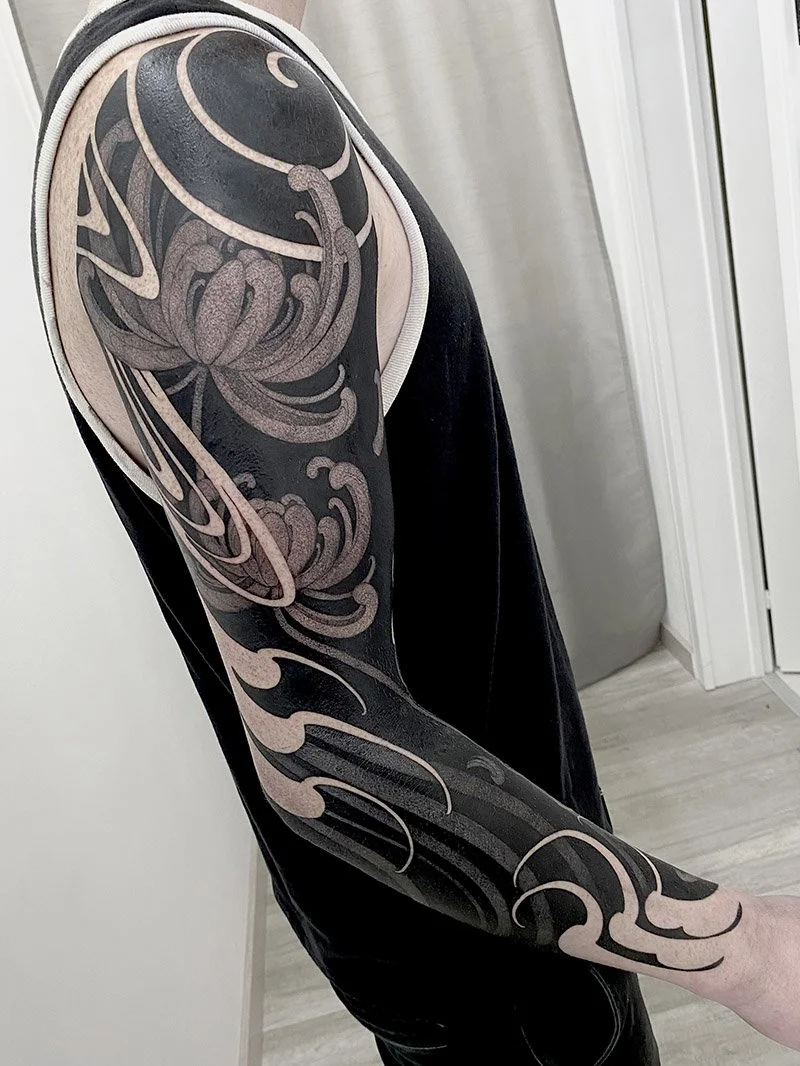
Federica: I have always been passionate about tattoos, but I was a big rebel in school. More than now. I bought a tattoo machine on eBay at 17 to tattoo myself. I started tattooing orange peels, and then I went to get some tattoos to learn how to set up properly and what supplies I needed to buy. Then, I knew I wanted to do it. I’ve never stopped tattooing. It’s like a drug. It’s my life. I never stop.
JG: You two are the same age? Met each other at the academy?
Federica: Yes.
JG: And then heart eyes?
Federica: I was with another boy… for the first year, but we became best friends, and then I left the other… it’s love. Simone was a big inspiration because he was so focused in school.
JG: You explained some of the programs of Alex’s school before we started recording, so I want to get back to that. You said you spent a whole year on anatomy. Looking back on the academy and those three years… what kind of things were important to you now that you learned at the academy? Of course, everything… but what’s the thing you think of the most that you learned from there?
Simone: I think the anatomy program lets you understand how reality works… even for Federica, it was really important to understand the anatomy of flowers and the shapes even when creating different effects with them.
Federica: I think in every style of tattooing, the most important thing is to study reality first. Light, shadow… it’s important for all the styles. We had a lot of other students who said they didn’t want to study realism because they wanted to do blackwork. But even in black work, you should know about light and shadow.
JG: Learning to draw the body would be exciting for someone who wants to do human figures. For other styles… was it still exciting? Or frustrating?
Simone: It’s a good challenge for yourself… to know something that can help you. When we saw the teacher, it was inspiring for almost everyone who saw what they had done, and it’s really inspiring because you can see his passion. To see him make 2 lines into a masterpiece. In the beginning, I used to just copy things. I would show it to the teacher, and he told me it was shit… not because it’s not similar to the image, but because it doesn’t represent anything. Just a copy of a picture of a face. I didn’t really understand how the face was done, the structure of the face. The studies we have done… Maybe I prefer the studies we’ve done because it’s more satisfying because I understand something rather than copying it like a machine.
Federica: If you take time for yourself to study and know what you like… now we are working, we have less time to try something new.
JG: How did you pay for the academy? Did you work jobs?
Simone: I finished high school and then did two months at University. I started the Art Academy the next year, so for the rest of that year waiting, I worked at a factory and in a wine factory in the summer. That’s easy to find here.
Federica: I worked also, instead of my last year of high school. I worked in a bar my last year to save money for school.
Simone: Also, Alex told us that someone quit after 2 years and started tattooing without finishing the final year. But that third year was the most helpful and important for studying tattooing.
In our job, we don’t look at what utility is. We try to do it well and epic, making the clients happy and inspiring others.
JG: Would you think that’s more arrogance or pride? Arrogance says I know enough already and can go off on my own… so arrogance leaves the school. But Pride stays because you want to be proud of completing the school. So you can have pride and still learn. In arrogance, you stop learning.
So, growing up in Italy, there is so much culture and art. Being raised in America, I can’t comprehend growing up surrounded by all this. The history of art here is unbelievable. So you are inside this history your whole life...
Where do you see yourself and the things you make and your creation? Where do you see that contributing to that ever-growing culture? When you’re young, you’re taking in the culture and history and learning and taking it in. Still, as an artist, you are representing that understanding. What you do is a re-presenting of what you understand from that rich culture. So, it is still a giving back… you’re contributing to the same culture that you’re taking from. When you’re in this rich historical culture and the art is so old… accumulating… and we tattooers are doing temporary… we do it today, and they could die tomorrow. Do you see any part of what you’re doing as a part of the continuation of what inspires you?
Simone: Because my style is realism, I get inspired by paintings and stuff from here; I see dark and light like Caravaggio. Even if I’m unaware, I am influenced by what I get here in Italy. In some ways, I can do things more forever, like painting… but in tattooing, yeah, for sure… it’s so temporary, but I’m not looking at it like that. Even today, looking at the buildings, why would they make them so extremely beautiful, like in Venice? There was a culture focused on what was nice to look at, and now, maybe society is more focused on utility. The buildings are faster to make in a straighter shape, and that’s it. In our job, we don’t look at what utility is. We try to do it well and epic, making the clients happy and inspiring others.
Federica: I don’t know if it’s an answer for you, but I’m looking to create something with interior design using drawings, something that lasts longer than tattoos. I want to tattoo forever, but I also like to do other things with my art. So I am thinking of making things. I am influenced some by the things I see around me and more inspired by different cultures.
JG: To be inspired by things outside of your environment. I think of an artisan as someone who is creative everywhere, like the Renaissance wasn’t just painting. I think it’s natural to have the craft you’re most comfortable with and then apply that to other things, to have an artistic mind to see design. To see the same things that you enjoy. Doing something like ornamental, seeing shapes rather than rendering an image... you can measure your accuracy with realism… you can see what needs to be more correct. It’s good because it’s accurate. In a more abstract shape or design, what’s accurate is what you like.
Federica: I like that so much.
JG: If you’re doing something like “this” movement, the only thing that would make it incorrect is that you didn’t like it. Wanting it longer or more arched,mand you enjoy it more. But someone else could look at it and not like it.
Simone: Like, what makes a good artist? It’s only what you are influenced by, and you see it and do it? Or it’s something you have inside? Personal taste… maybe it’s a combination of inspiration, good taste, and willingness to practice… but it’s also something more you have inside. Someone may do good tattoos, but maybe I don’t like them because I don’t feel that.
JG: It’s one thing to photograph it, reference it well, and then go up the stage and win an award.
Simone: Exactly.
JG: To create a story is different. Lots of references and knowledge. Movement and layers and forward and backward.
Federica: The other people, maybe if you show them a tattoo or one of my tattoos… They usually prefer his because it’s more connected to reality they can understand. It’s objective and well done. It has more impact on the general public.
Simone: It seems like a face; it looks well done, and they like it. For Federica’s tattoos and something like Japanese woodblock prints I am absolutely in love with them. I see all of the work behind it and even the faces.
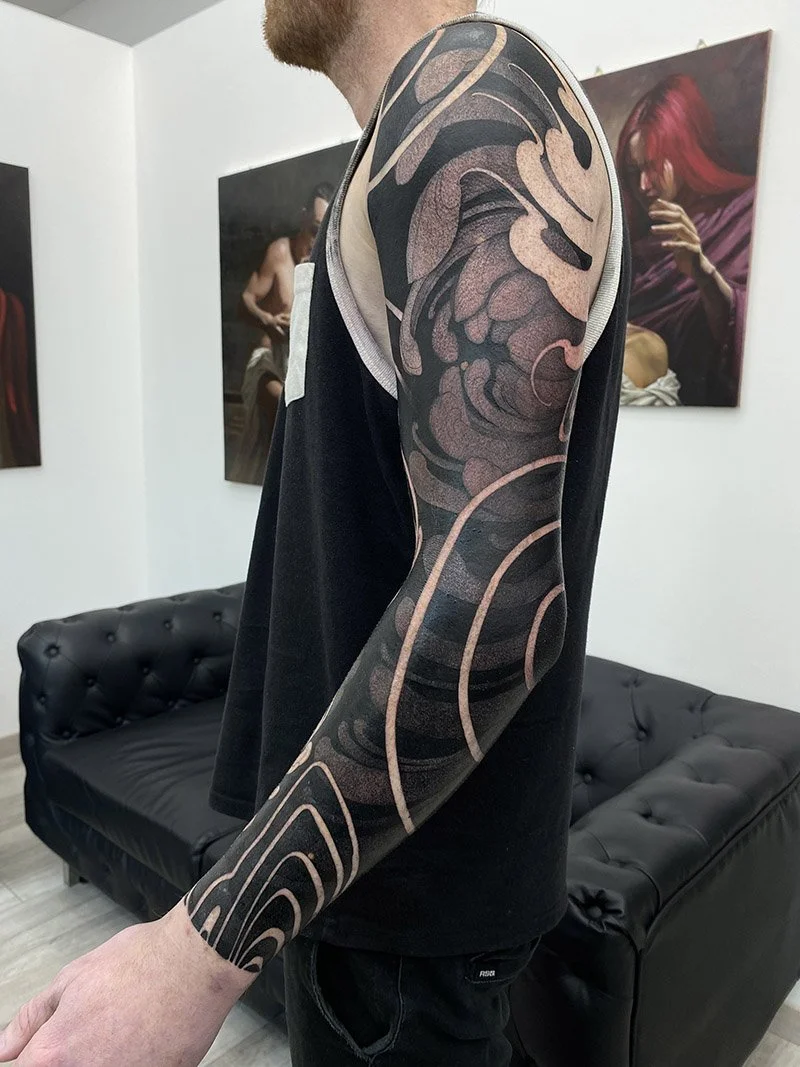
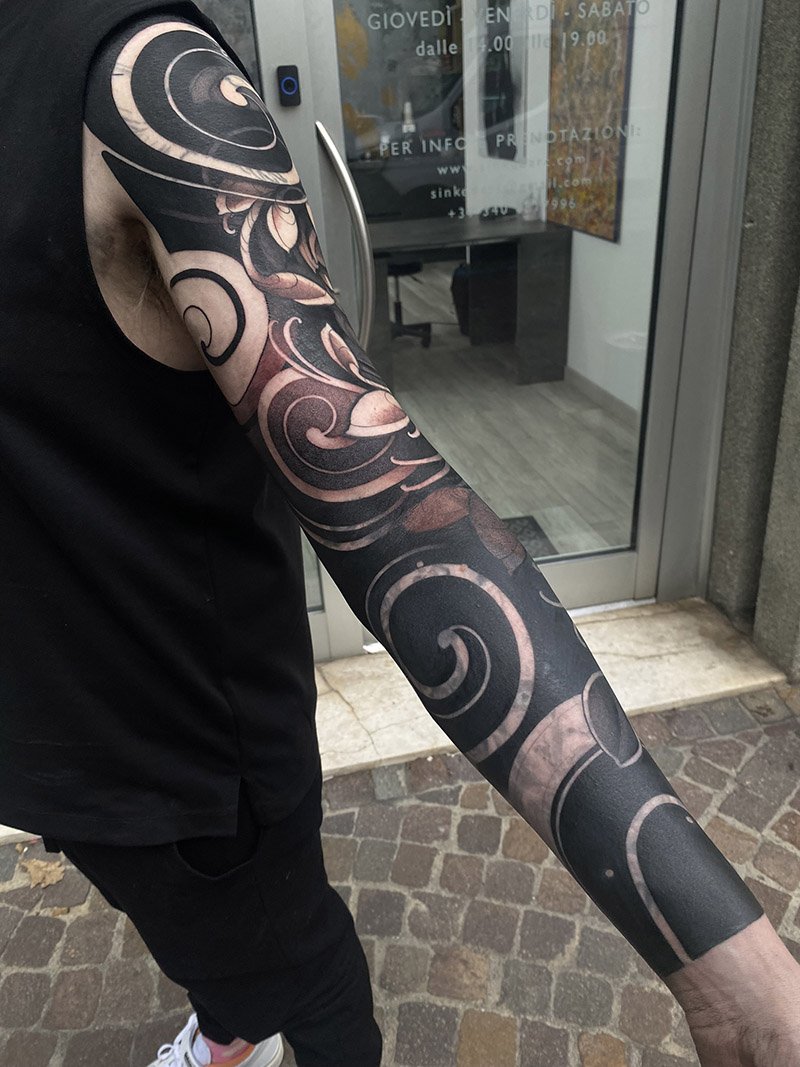
Federica: But if you show it to my mother, she won’t like it. When I started to do this style, I was always near Simone. It was sometimes stressful because people saw his tattoos and always loved them. Maybe they see my flower and like it, okay, but they still like his tattoos more. It was a bit stressful, but it’s okay now. There are lots of different types of tattooing.
JG: When I started tattooing, it was similar to when I was young. If I drew something from my imagination, it looked childish, but when I replicated something, people say, “You’re a great artist. You’re so talented,” and it always felt untrue. I could copy well. But with tattooing, I often had to create things on my own, and it looked immature… so I started replicating things instead. Realism… details… but details might not be real. We use words like hyperrealism… but you can’t get more real than real. Maybe more detailed. Maybe hyperrealism is making real look like fantasy. Or surreal. Perhaps it’s surrealism. You can be creative and artistic with realism or simplicity; both are great.
As we discussed, the tattoo world is so big now. There are so many good tattooers. So many people can do everything and are so good. You can look on your phone and find so many amazing people. It can feel discouraging. Is that okay? Do you feel discouraged or competitive?
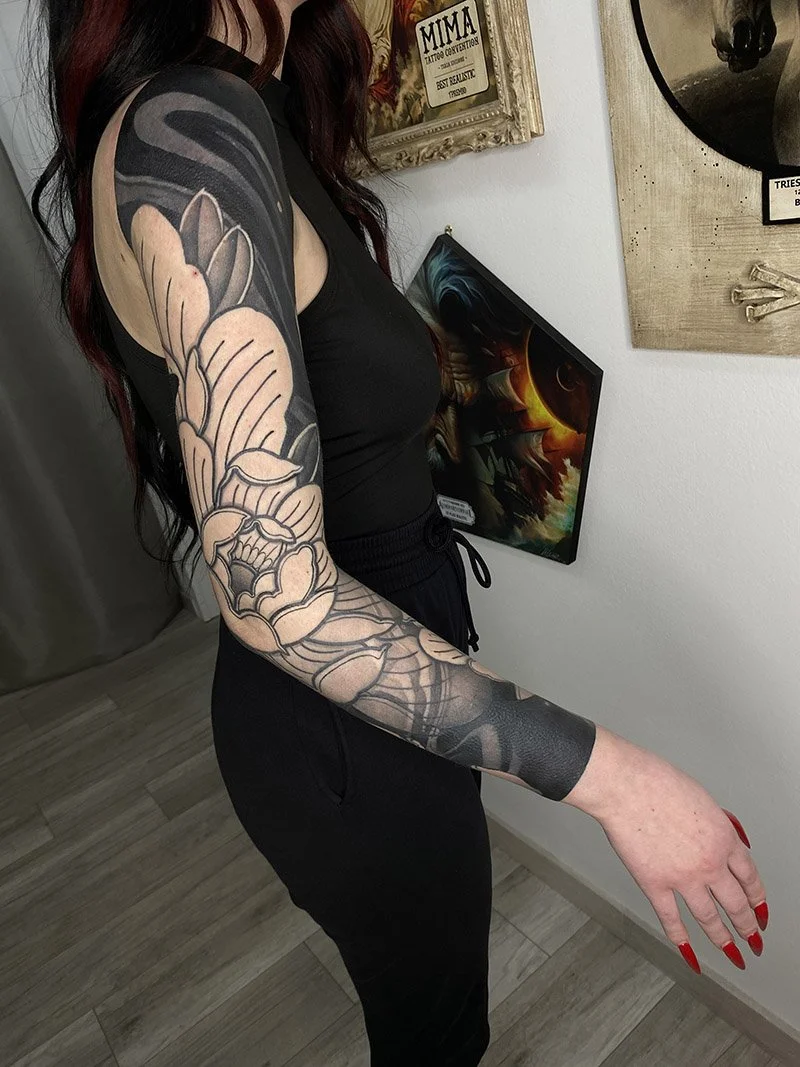
Federica: The first time I saw a nice tattoo, I thought maybe I’d do other work… but then I had my way of doing things and wanted to feel inspired by the different artists.
JG: When I started tattooing I was insecure, so I wanted to win. I wanted to be better than the good work I was seeing. There was a point where I couldn’t get better than what I was seeing… but everything was being done, and everyone was so good. So I decided to be as good as possible, and the competitiveness isn’t a big deal.
Simone: Being good at tattooing… is it if someone else recognizes how good I am, or is it Instagram followers? Many things can be seen from the outside as being “good.” At first, when I graduated school, it was maybe easier for me to be acknowledged because I was the only one doing realism, so I stood out. There are so many good realism artists worldwide, but I think I can still be recognizable.
JG: We walked through the Accademia Venezia, and from the outside perspective, no study— just looking at pictures— they all look the same to the uneducated eye. All the people that painted from whatever era… they all look the same... There’s all these amazing artists, some students, and some masters, but after a lot of time, they’re just part of it. They spent their life being artists, but they are not recognizable individually unless you really understand. Maybe as tattooers, we can become like that, all being a part of what tattooing is now, but it is difficult when you want to feel like you matter.
Simone: It’s also good to see someone else work; we saw tattoos better than ours in Milan, which motivates you. I have to do… I have to study. And that’s good. But focusing too much on others’ works may not be so good.
Federica: Alex told me you don’t have to do what you like, but what are you good at? I started to do color realism because I loved it, but it was so stressful. For me, just, the flowers were not competitive with the others, but after practice and modifying, being inspired by ornamental blackwork, it was at the beginning just a flower, and now it’s something totally different.
Simone: Like at a convention, maybe someone sees you from the outside saying they prefer you do this vs. that… also singers that change style go through that, and people prefer them when they were doing their other style. But they don’t understand being an artist. When you’re an artist, and you do what makes you… you have to flow.
JG: Always growing, never want to stay the same.
Simone: Yes, change and change.
JG: Maybe being good at tattooing is not so important. I think being a good person and having good understanding, passion, authenticity, and integrity. I believe those are the most important things. Then it doesn’t matter what style you do; tattooing is everything, every tattoo there is. Tattooing is the little, bad, small, silly tattoos… because if we didn’t have those, we wouldn’t know what we like more or what is the best? What do you think are the most important things to strive for? Is it okay to be really good and an asshole?
Simone: If you choose to tattoo, you also interact with other people, so how you behave reflects your work. Sometimes some assholes are good at tattooing, but people can feel it. For example, so many artists in Italy are doing the Chicano style. It’s a trend that everyone does here and is really popular. We met a lot of Italian artists that became famous with that style, not doing completely traditional ones, but maybe changing some things; they were still appreciated by the artists in LA because they had credibility to their work from their study and understanding of it and respect for it. I appreciate someone who does good work, has credibility, and understands what they are doing. Sometimes, maybe even someone is putting together a really nice Japanese tattoo that might look even better than the Master. Still, I would prefer the Master because of his credibility and what he has done for the industry.
JG: Yeah, that’s the big picture. We have cultures from different regions, but as people, if you take something from another culture because you like it or you can sell it, you can appreciate something and be inspired by something… like we had really good Italian food in Japan because they had an understanding of what they were doing and their culture demands it being done as good as possible and with your own heart. It was the best Italian food I’ve ever had… they weren’t Italian, but they clearly cared deeply about what they were doing.
Simone: Credibility on the culture and the equipment, too. When Federica started doing large floral stuff, she tried to use old coil machines, but it wasn’t her thing to use old coils. But she thought it was important to know. So be yourself, but respect the past and take something from the past, something from the present, and do your best.
Federica: You can try all the styles at the academy and see what you like. It’s really great to be able to do that.
JG: Yeah, I tried all the styles on people. Hopefully, some of them died by now. I’ve done it long enough.
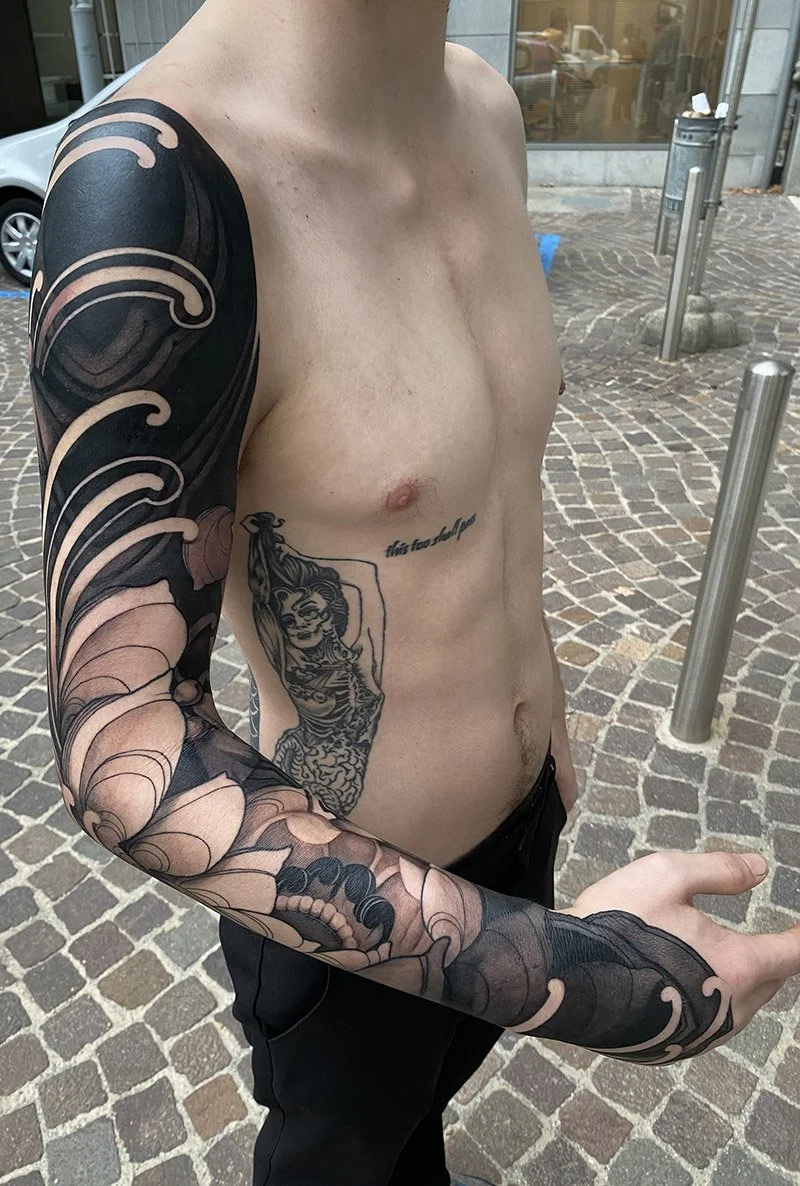
Simone: Alex tells us that he did a random client three coverups of his own tattoos… and his customer still trusts him. And then, after five or six years, another coverup.
JG: It’s great when you and your client grow together.
Federica: Everyone has to do bad tattoos.
JG: So, what do you desire as a tattooer to reach or grow to? To do something? To be somebody? To have something?
Federica: Honestly, I don’t have big dreams. Because I have a shorter step-by-step mindset. I would love a studio in my house so my client can come in the morning, have breakfast together, and talk a lot through the design. I would like to win at Milano, but it may not be for me. I want peace in my mind. During this year, I see Simone get goals before me. The first time that happened was stressful, but I’m happy about my journey because Simone didn’t rush. He was in Milan the year before; this year was my first. I am happy and feel no rush. He has done a lot of guests, and I just did my first one in London. But I am happy because I trust the timing. Before the big dream, I first had to do my in-between things.
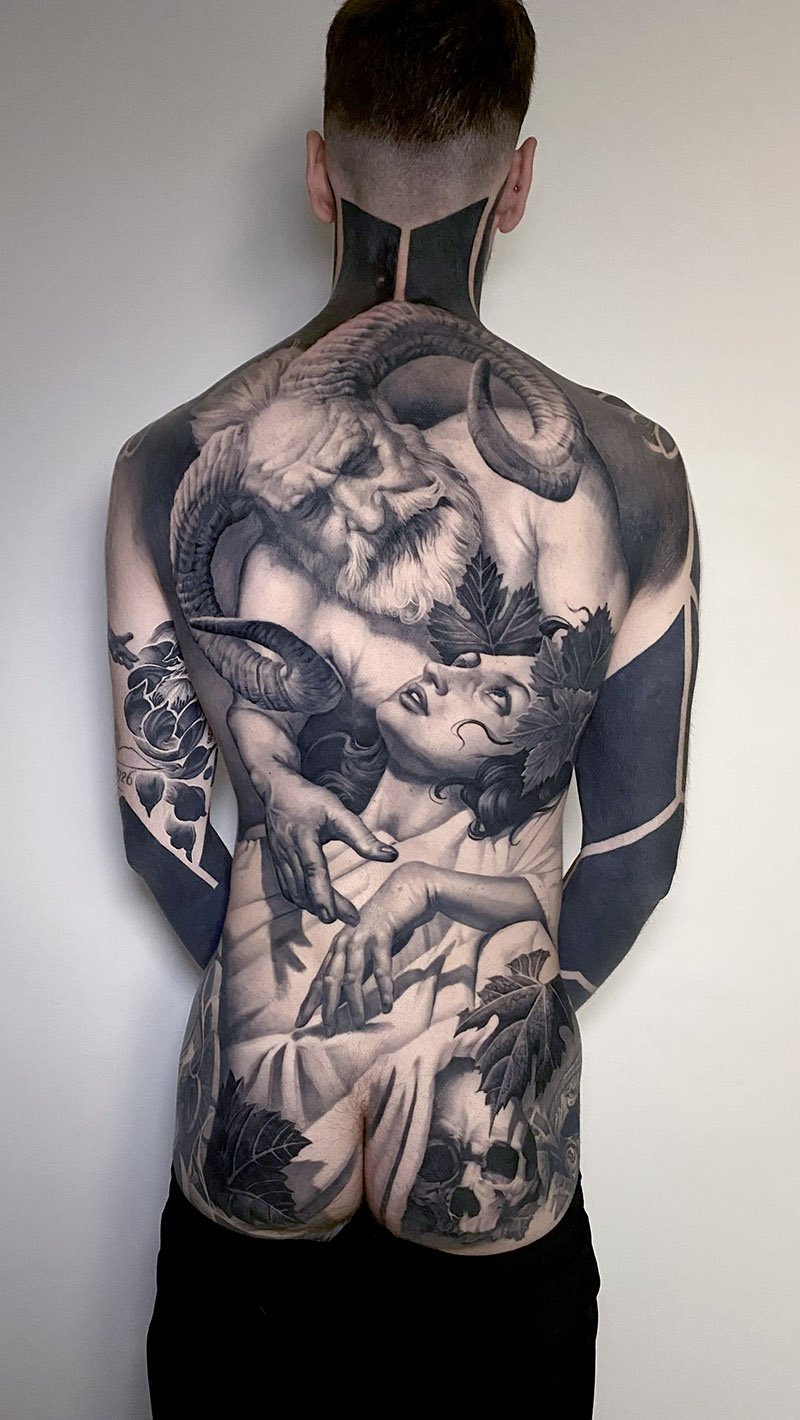
Simone: Alex makes us write down our goals for the future. And he has us write down the goals for five years. We have to do it all in five years to help with our mindset. When I was at school I said in five years I want to open my studio with my brother and one and a half year later we are here. I like to separate the material stuff from my artistic shops; I don’t want 10 shops because your focus is on the business, not the art. So, I decided to become respected by other artists and be an important member of the tattoo industry for black and gray realism, which became my goal. More artistic goals and less money focus. It’s a well-paid job, so you don’t need to become a millionaire. We have time to do what we want to do step by step. In the beginning, we worked a lot on realism, and she could not do the pieces she liked to do, but now she has more fun and can choose clients. Clients will say do whatever you want; I trust you. And it is rare for someone to give me that kind of freedom.
Federica: But I think I did forty tattoos for free to get to this point. I worked free for one year to show people what I wanted to do with my style in tattooing. Alex told me I had to teach the new things to the people first. My flowers were something new, so people wouldn’t ask for what they didn’t see.
JG: Did you make concepts?
Federica: I always do concepts. The tattoo at the end, the “owner” is the client. It’s important to me that they see it. If they like it, I do it. Maybe they say they don’t like it, I’ll change it. I’m not the type that won’t change it.
Simone: So now I’m working on myself, maybe slowing down on tattooing, thinking more about the design, and doing some discounts for them. I can book out every day with a realistic lion. 700 lions per day. But it doesn’t make me happy. As far as future teaching, I would be more interested in participating in the academy rather than doing just a one-hour seminar.
JG: I think it’s crazy to want to tattoo so bad in the beginning, and then later on, you want to make and sell some product so that you don’t have to tattoo anymore. I see so many people who strive to get tattoos and want to do something else as soon as possible. Alex is a world-renowned, accomplished tattooer who wants to race cars. Some of that is just changing as a person, to like it until you don’t like it anymore.
Simone: Alex made many things for the tattoo industry and then totally quit it. That’s his choice. But if I see Nikko Hurtado still in the game, still admired by so many people. If I had to choose… perhaps you prefer to be in the glory of that tattoo industry, or you would rather quit everything.
Federica: It depends on the people around you. If I were Simone’s wife, I might start telling him not to go to work so much. We’re influenced by the people around us.
JG: How do you feel towards your clients? We need people to tattoo. What makes it so unique is that it’s on a living thing. They are bringing this desire to you… Sometimes, we use people to get to where we want to go artistically… what’s your perfect client? Do you care about them? How do you feel about them?
Simone: For me, it’s hard when clients give you total freedom to do whatever you want. I may have a lot of ideas, but when the client comes up with an idea, it’s better for me because I can create something unique and original from there. Connecting with them is important because when they say, “Do whatever you want,” I go crazy. I do not know what to do.
Federica: I will have to tell him what to do.
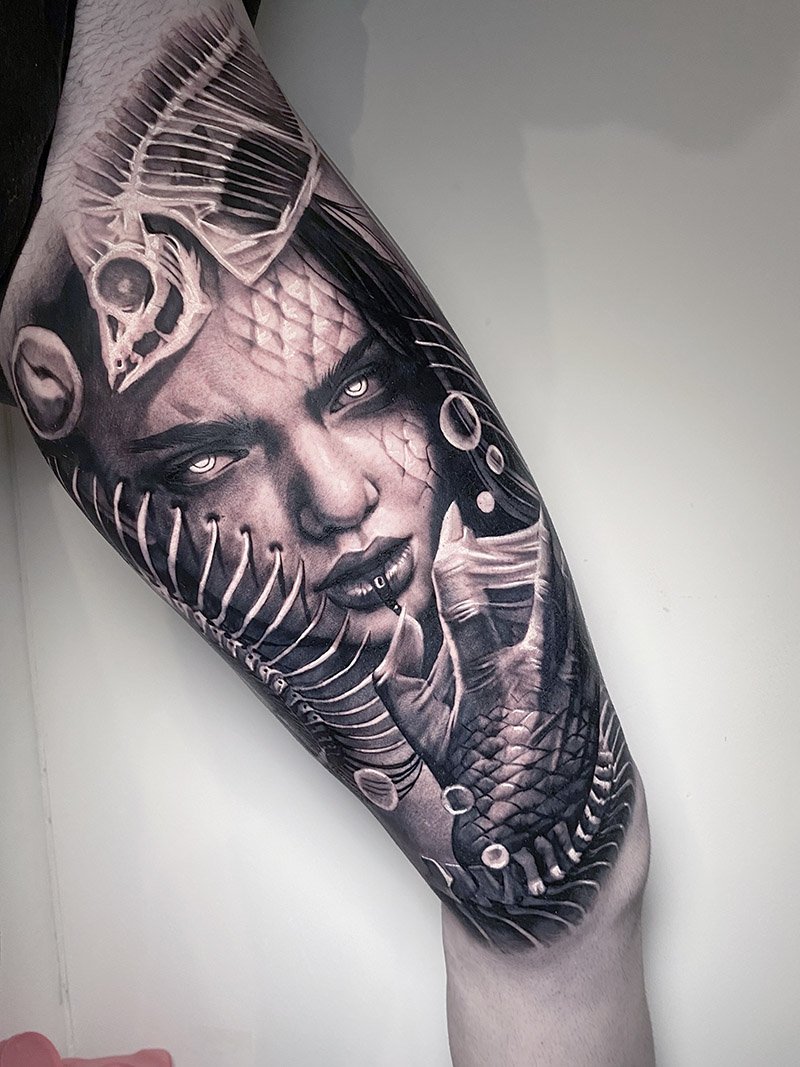
Simone: It’s a total crisis. I may have an idea ahead of time and offer it up, but sometimes, the tattoos I’ve liked the most are the connection with the clients. Sometimes, they have good ideas that you can represent well. Once, a client wanted a dark siren with skulls, and it was really inspiring for me.
Federica: The ideas are less important to me, but the client is. I do it more elegantly if she’s a “good” girl. If it’s a suicide girl, maybe more black. The personality of the client guides it. I always appreciate talking with them and understanding them personally. The perfect client, I have a lot of them. They send 2-3 ideas and then say to do whatever you want. I don’t have problems with the clients because my style is my style, so they have to trust me a bit.
Simone: Sometimes, when the problem begins, it’s hard to explain to them that it’s just a drawing and will be totally different on the skin.
Federica: Another stress for me is having an exact date. Next Friday, I have to do this tattoo. Sometimes, I can draw it in one hour. And I have not drawn it ahead of time. I draw from 0; I am all on my own in coming up with it, so I can’t force it sometimes. Sometimes, they have to wait. And they understand.
JG: That’s the good news now; the good news is if you don’t want to do it, you don’t have to. I was the only one living in my town, so I felt I had to do everything. Then I moved to a bigger city, but I was the best one there, so I had to do all the tattoos to keep them from getting bad tattoos. I wanted to do it all. Now, there are tons of people who are better than me or don’t charge as much. Now I’m just happy to tattoo.
It’s really nice talking to you guys. We were just here a few months ago when we met you, and when we told people we were coming back, they were like, “Why?” And I said it’s because I want to talk to these two people. I had a good conversation and want to speak to them again.
Simone: I thought you were coming for Carnival.