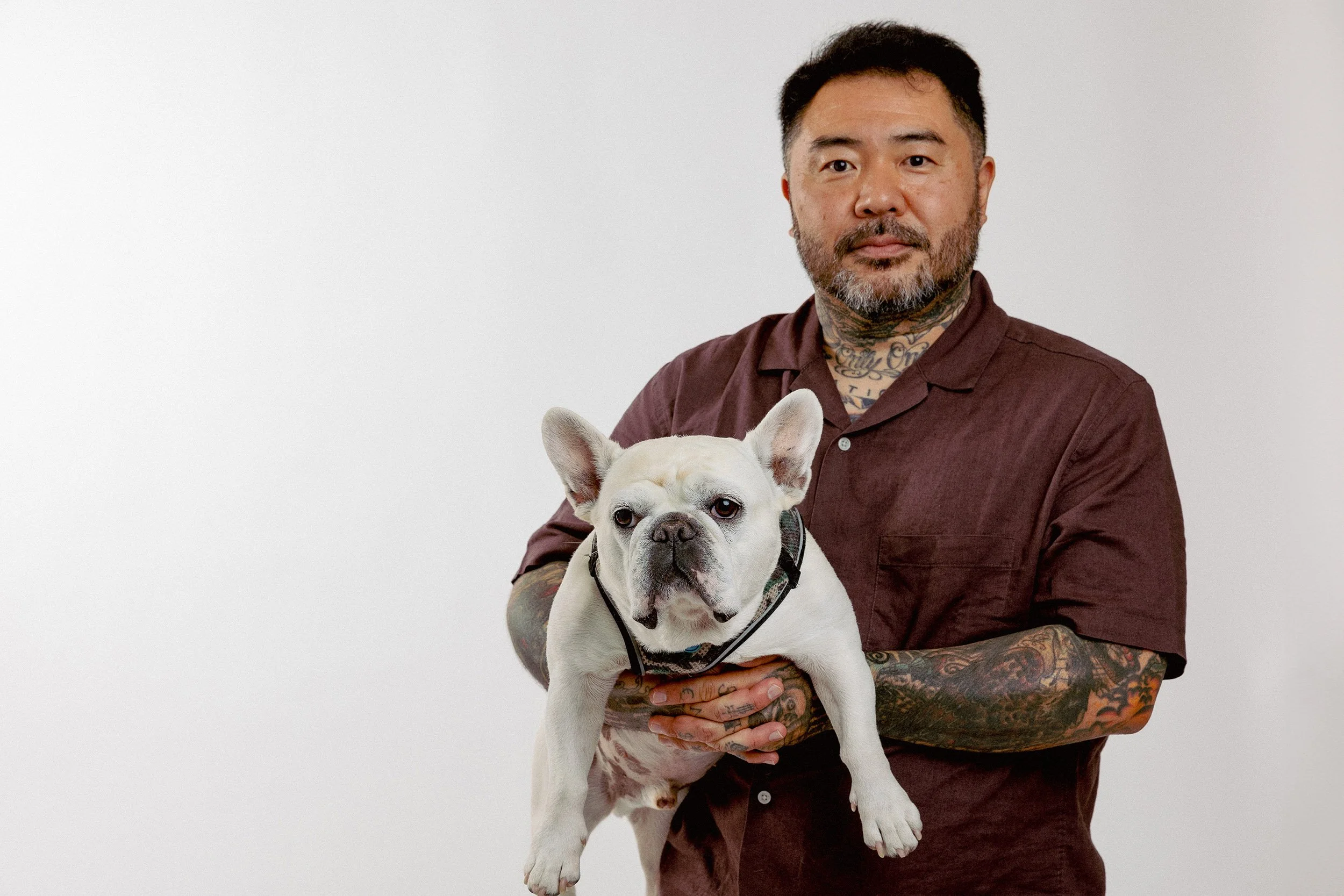

A Conversation with
Interview with Jeff Gogué
@stateofgracetaki

Jeff Gogué: I came into tattooing in 99, knowing nothing and literally just fumbling through for years, up until now. I’ve never really felt like I belong. I’ve been told I don’t belong. I’ve been told I don’t deserve to tattoo. I’ve been told these things, and when I already have that voice inside me, pounding away. To have outsiders telling me that really fortified it. So stubbornly, I’ve stayed in, but that has left me perpetually insecure and wanting to be accepted. Still, I’ve been misguided by who I was trying to find acceptance from. I had this combination of mass “popular” acceptance from people who know nothing about tattoos. I have a surprising amount of acceptance from people I respect and know so much. It’s classic imposter syndrome, which of course, I don’t want to be just a typical classic imposter syndrome dude, but obviously, I’m pretty typical. You know this whole conversation needs an esoteric understanding. It requires being involved in tattooing to understand it. Outsiders don’t understand because they can only see it from outside of tattooing or being tattooed. You only understand it if you are in it, right? I could love ballet and watch ballet and appreciate ballet, but I’ve never done ballet, and I can’t dance. I don’t have an esoteric understanding of ballet. I have an observational understanding. I did want to get a couple things clear. I know that we were both born in 1973. I’m proud to be a little older than you, having been born in March and you in December.
Ryudaibori: Yeah.
JG: I was humbled to see that you started tattooing in 1998, and I started in August 1999.
R: I got tattooed by Paco Excel and then the apprenticeship with him and Adrian began in 1997.
JG: But then, really quickly within that year, you started getting tattooed by Horiyoshi III and became an apprentice of his. I remember hearing that the first time I ever heard about you. I was told that and that you’re a 10-year apprentice. I pictured you living in Japan and working in his studio.
R: I would call it a satellite apprenticeship, and obviously, there are parts of it, I could say, that were less difficult in time commitment than say, what Horitomo did. But at the same time, I don’t think it’s lesser in terms of what it was because it was what HE wanted. That was something that would come up: “how did you get in there?” It wasn’t something that I got into. He offered it to me. You really think, as somebody that’s been tattooing for six months? I thought, I wanna be knocking on that door... like, hey man. You know? But I realized as time went on that he was building something. You know, cause that same year he invited Alex in, titled him (Alex Reinke, “Horikitsune,” Holy Fox tattoo). But it was because he wanted to set up a global thing, and he wanted someone in Europe. I even said it... “If I’m gonna be an apprentice, if I’m a member of the family, does that mean I’m going to move to Japan?” That’s what I assumed, and he said, “No, no, I need you out there.”
JG: Yeah.
R: I think it became clear really quickly, there was a plan and I had a mission. When did you go to Japan to get your back done by Shige?
JG: it was 2010.
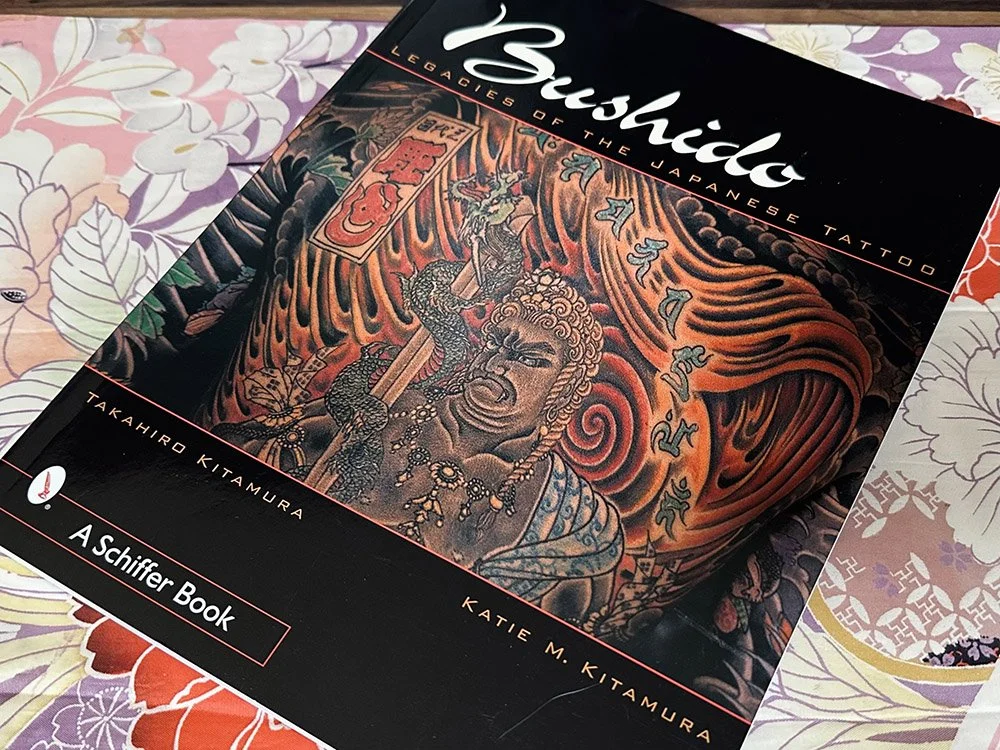
R: Yeah, so for me, that was in ‘98, I got tattooed by him for 10 days in a row. It was like a whirlwind, and it is nothing short of miraculous and amazing, and that culminated in the writing of my first book, Bushido. And I think about stuff like, the reason I asked you when did you go is because, think about Hardy (Ed Hardy) and Doc Forest going in 1973. And you know, think about how magical that world was back then?
JG: Yeah, yeah.
R: Even when we went, it was so magical right? But I would say even now, any American, or any foreigner for that matter, going to Japan now. It would be a magical experience.
JG: It’s magical, but in the 13 years from when I first went until now, it is totally different.
R: So much, right? And so, for me, I just saw it as this is the road... We’re just doing this. Obviously, there’s a lot of hindsight, you know, as many people are aware, I ended up leaving the family, and so not everything went perfectly well there, but I think there are just times where you just try and do things. And we look back later, even the stuff you’re saying about how you feel or felt about tattooing and whatnot. We all feel that way. I threw a convention for years, and when I’m on a convention floor, I feel like I’m looking at a high school lunch room; You got the goth kids, the trad boys... you’ve got the Japanese tattooers, the indigenous people. Everyone kind of factions off. I think we like to think that there’s a lot of openness, but at the same time, we are a microcosm of a larger society. We will still have many of the traits of the larger society. Some might be negative, some might be positive, but even within all that, we’re still gonna have the cliques and the social politics and whatnot because we’re humans, you know? But I think it’s nice what we’ve both been able to do.
We’ve found something that we really love to do, and we found something that I think we both have a certain degree of skill in and something that enough people want.
Think about the gratitude of having people that wanna get tattooed by you. Right? I have been spoiled. San José is a tattoo town. When I had no idea how to tattoo, people still wanted to get tattooed by me. I’ve been so lucky. There are so many things... like you guys are embarking on Olinjär. When I got into making tattoo books, I had no idea what I was doing. But I decided I’m just gonna do it. I was following Ed’s (Ed Hardy’s) lead.
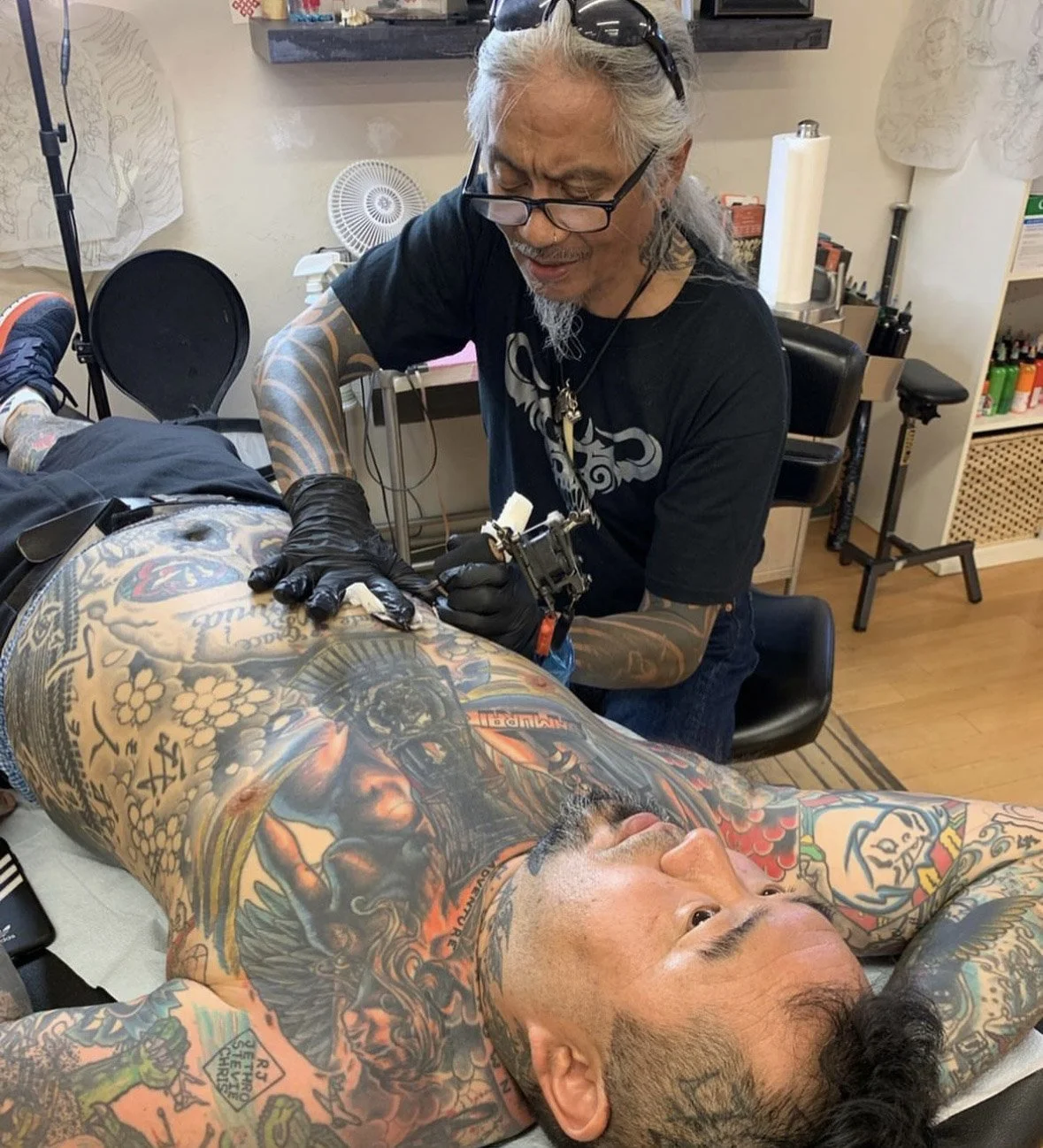
Getting tattooed by Leo Zulueta, 2019
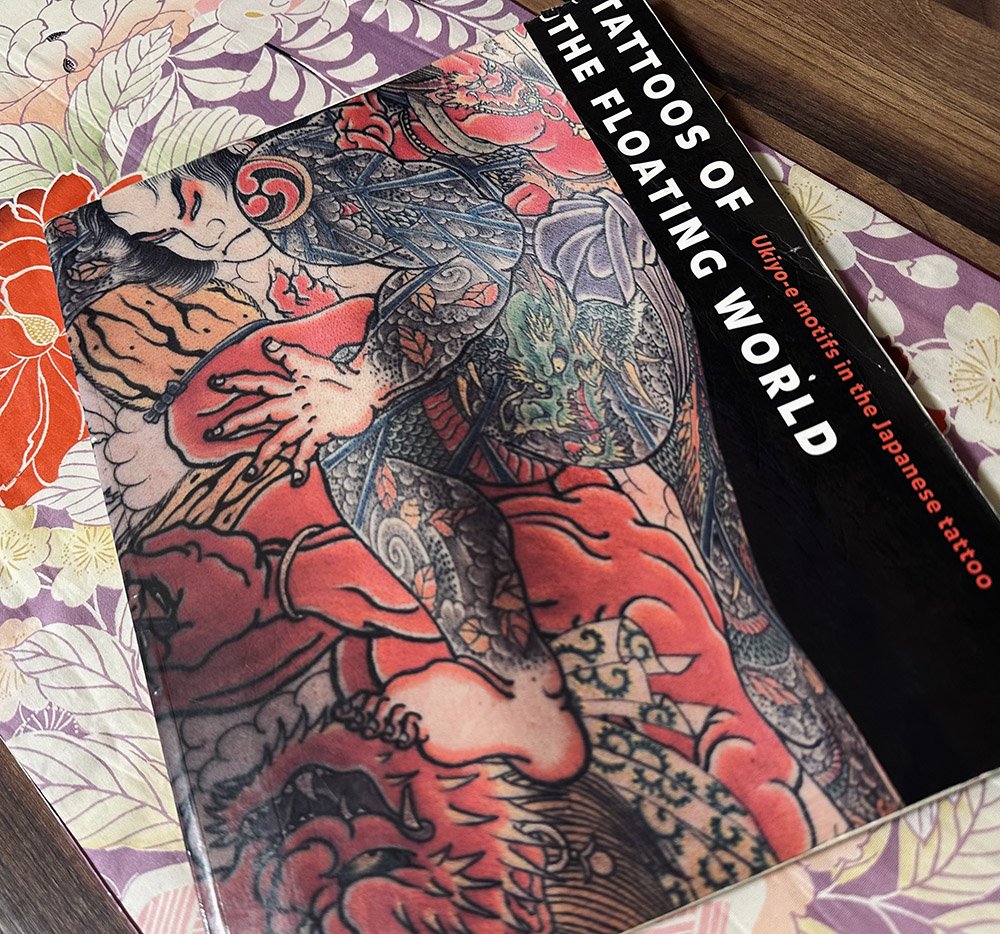
JG: It’s unbelievably impressive, especially the quality of what you were doing. You were doing it so soon because Bushido and Tattoos of the Floating World were two of the very first tattoo books I ever owned. And you wrote those at the very beginning of your tattoo career. I bought The Japanese Tattoo, which was from 1987.
R: Yeah, Sandi Fellman’s book, best photos ever.
JG: It’s amazing. And the introduction is impacting when it talks about symbolism in our culture being dead, and that was over 35 years ago. I’ve made a lot of people read that introduction. It’s talking about people getting football stars and tv icons and names tattooed on them…and…
R: Yeah, that was probably, at the time, one of my most important books, but I take that text with a grain of salt. But as far as the photography, it’s unparalleled, but yeah, because you can’t take something out of a time-space-continuum. I know I mentioned Hardy. When you look at what Hardy accomplished. The other day when we talked about Hardy and Leo (Zulueta) and what they’ve done, it’s because, you could look at the time-space continuum, what was known back in the 70s. We’ll never be able to show Japanese tattoos to America the way Ed did. Or Leo, the way he spotlighted specific tattooing, and how it became the “tribal” movement. Because it’s already out there now. It’s just one click away on your phone.
And the same thing, Bushido was huge for me. When I wrote that, I just had to do it. Because I was thinking, this is crazy. This amazing, magical world of Japanese tattooing. I was so blown away by it then. And sure, admittedly I romanticized it inherently as a Japanese American. There were so many things I needed it to be for my sense of identity and pride and whatever. But I had an amazing time, and I felt that I gotta write about this, and that was my background in school (Bachelor’s degree in Community Studies, UC Santa Cruz). You do a field study, you observe, and you write about it. So essentially, I treated it like that. It just so happened that my younger sister was back visiting my Mom in between college and things, so she helped me with the writing. She’s a far better writer than I am. So we had a 70-something page manuscript, and then we’re like, well shit. Maybe we can get it published. You know, at that time, there weren’t 50 million tattoo books out there. Remember, this is 1999, you know? So we picked 30 publishers, many of whom we felt might be sympathetic. I think out of the 30, I got a bunch of letters that said, “You can’t do this without an agent.” and then I got two back that said, “Yeah, we’re interested, but we need photos.” and I ended up going with Schiffer. We made another trip to Japan, but my budget was very limited at the time. I told my buddy, “Hey, I’ll pay for your flight and hotel. You shoot some pictures for me.” He was a skateboard photographer and said, “Hell, yeah!” So we went, and we literally had two remote flashes and a roll of black paper.
JG: That’s crazy…
R: You might think about that kind of equipment, even equipment the (photographer) guy will bring today. Tens of thousands more dollars than what we had. Back then, we made it work with what we had.
JG: How did you pay for that, then?
R: Out of my pocket; there was no advance from Schiffer, or at least not for me— a first time author. They had no idea what was gonna happen with a tattoo book. To be fair, I was just happy to get published, you know? But that book really changed my understanding of publishing and what I wanted to do. I mean, it won me the respect of Ed and how he treated me. I think it showed him that I was worthy of mentorship. So he began advising me and introducing me to people, and you’ll notice in Tattoos of the Floating World, Donald Richie wrote the forward, and so did Ed (Hardy). So that was a direct culmination of what happened there. There are a lot of similarities, a book is just like a back piece or a magazine. Where I look back and think, “Wow, I was so stupid.” Or “I was so young and naïve.” Obviously, I’d write a very different book now, with what I know now, but it was very honest at the time, and I think that’s all it is. And I also think that when people look back, if you did your best, then that was the best you could do. It’s like we talked about the other day. If you never publish anything, then you would never be wrong. Or you could never change and grow, right? And I think people that are doers just do.
JG: Yeah.
Tattooing has always been there in one form or another.
With a tattoo, you need to accept it’s done at some point.
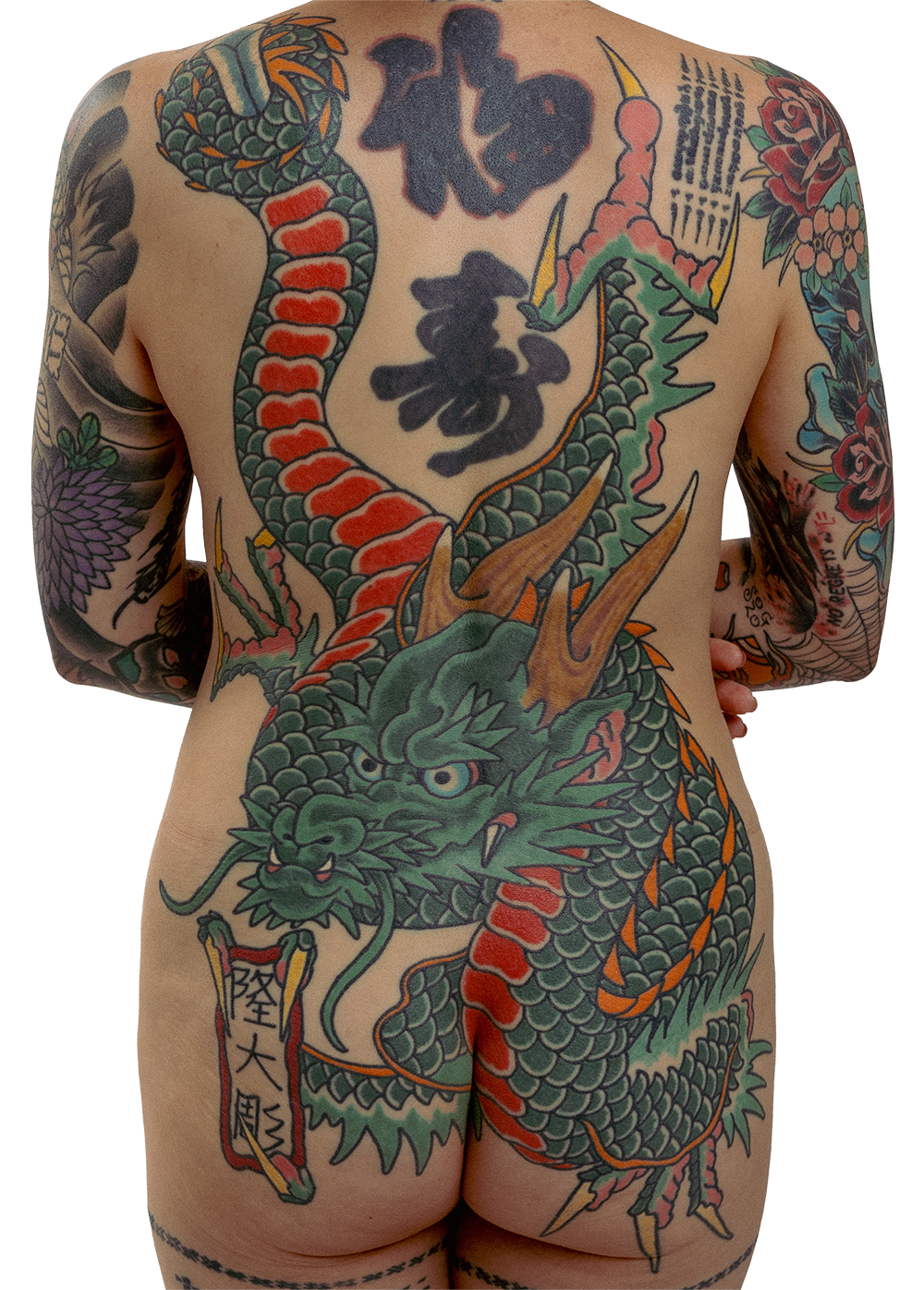
Think about the gratitude of having people that wanna get tattooed by you. Right?
R: And I think sometimes every book we’re chasing… we’re kind of trying to beat the last one. You know what I mean? And then there are times when we get these fleeting Moments of satisfaction. You know, CCP censorship aside. I’m very proud of that Pinky book. In so many ways, I feel like I did him justice, I did San José justice. I feel like I did a task for Ed that he needed to be completed, and I think I offered something that will be great for tattooing.
JG: Yeah.
R: You can get into all the different historical ways, and, that’s important, but I think it’s really important that we do that stuff. Ultimately, I used to say this back when tattoo publishing… I mean, actual, tattoo publishing essentially started with Hardy Marks, and then from there, it kind of branched off, but, before Ed, I’d see a lot of stuff where, especially talking about Polynesian and indigenous tattooing, and even Japanese tattooing, where it’s just like flat out racist shit. “Oh look at what these brown people are doing.” Kind of thing, or there’s a line in that Fellman book, (The Japanese Tattoo) “If you made love to one of these…” Like, really, dude? You’re talking about my master’s wife… Come on, man! Did you really have to interject that? but whatever. It’s still a great book, but… That’s why I’m saying, “You take it with a grain of salt.” but I’ve always felt like the success would be that… For example, It’s not just having something like Olinjär as an opposition to some crap magazine. It’s just that, as tattoo people, we should have the choice of all of these. There should be a spectrum. You know what I mean? Because some people want the garbage stuff. Some people are people who have no taste or whatever. Everyone’s tastes are different. We aren’t the tattoo police. Everyone has the right to like whatever they like. We talked about this briefly yesterday, if I see something that displeases me or that I’m not into… Whatever, that’s fine. It’s a free country. But I’d rather promote something or somebody that I believe in. And I think that’s, on a large scale, I think that’s what Ed Hardy did for the whole world. He was like, “Samoan tattoos are really great… Let me invite Petelo to Rome.” “Oh, this is really cool. I’m gonna invite Nakano (Horiyoshi III) to Rome.” You know? He got all these people from around the world and showcased what tattooing had to offer. And I feel like we’re still doing that.
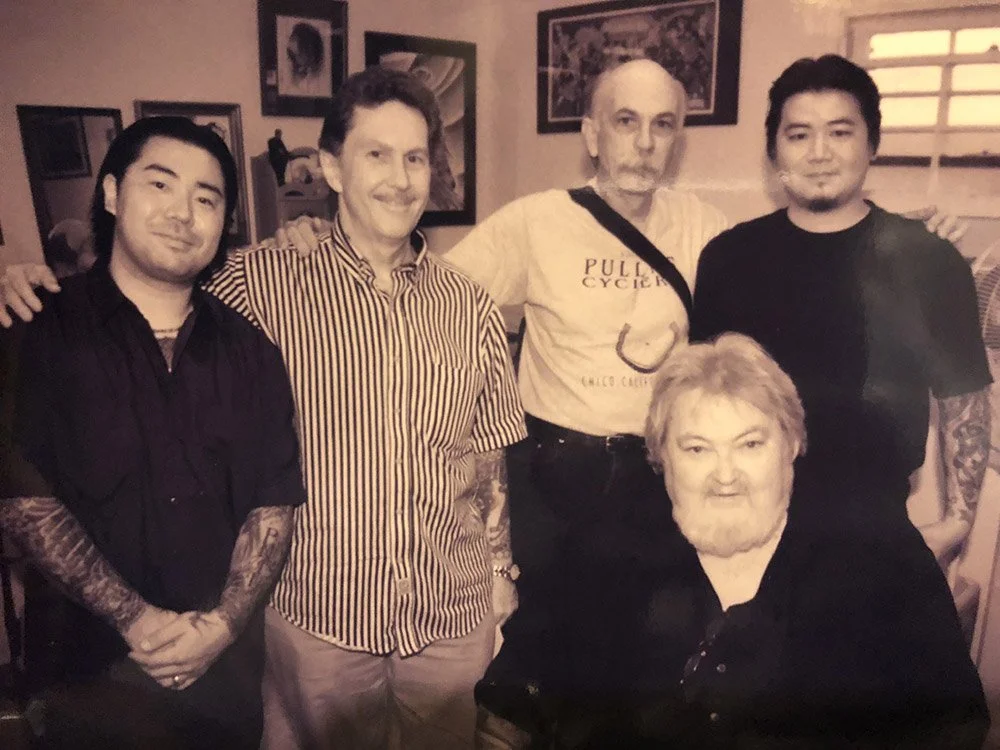
State of Grace Tattoo Opening Party, 2002 - Taki, Don Ed Hardy, Chick Eldridge, Mike “rollo” Malone and Horitomo, 2002
JG: Do you think Ed was criticized for sharing too much?
R: I remember Tattoo Archive, Chuck Eldridge; he had these newsletters sharing tattoo history, and this was like in Zine format, but well before there was a lot of tattoo publishing, and it was very important back then. I met him in the late ‘90s or early ‘00s. There’s a really great quote in one of those newsletters that says, “The newcomers are ruining this industry.” some old dude said it, and he’s talking about Ed.
JG: Every generation has that.
R: Yeah. I’ve also been told, “You shouldn’t give out that info.” If you look at all the old Tattoo Times if people just knew how to use the bibliography... Ed always puts every reference there. He’s always been that guy advocating for the level playing field. And with Ed, it was just that he had such a pure interest and love for it all, he couldn’t help but share it. In contrast, I’ve met people. I remember in the 90s, people saying, “Don’t tell people about this book because we don’t want them to have it.” I remember the first couple of Tokyo conventions, and there’d be tattooers there buying bags of Kyōsai books and coming back like, “I got this gold.” I still believe in libraries and books. I’m not immune to technology; sometimes it’s faster to google something than go to your house and look for it, but that shouldn’t be your only research. It’s funny when people just Wikipedia something and post it, something they don’t even know. It’s super obvious when its a cut and paste info drop, haha.
JG: You can’t trust anything; that’s why I like to write memoir style, reflection, and opinion.
R: There’s so much erroneous information out there. I remember reading a very well-known Yoshitoshi book, respected by everyone, and telling my ex-master about the part where the carp kills Oniwakamaru’s mother. He said, “What are you talking about?” He explained that wasn’t what happened. I was like, “But it’s right here in this book…”
I just got this great book about Yokai written by a Japanese dude. It’s a fantastic book, but there’s incorrect information in that…and it’s written by a Japanese professor.
JG: That’s the history of humanity… everything is passed down through each generation, whether telling it, writing it down, or painting it, and then everything gets translated and re-translated. We even re-translate our memories as we remember them. We can recall them differently.
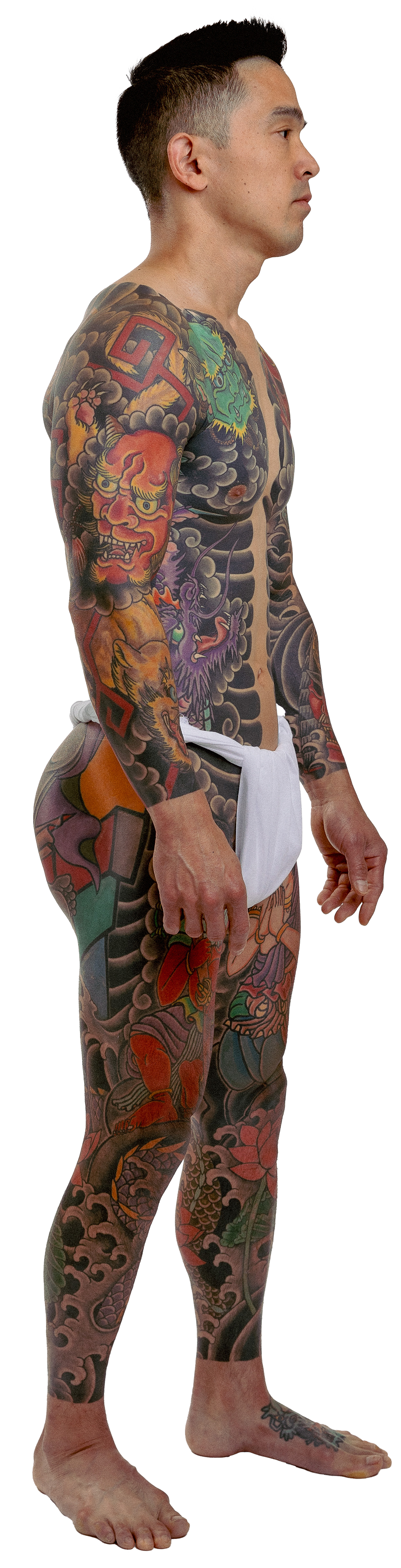
R: History is written by winners of wars; whatever happened, there are not just two sides; there are probably 12 sides to a story. It’s so vital for me, especially anything I do with the museum; I always preface it… for example, in the Tatau Exhibition, an exhibition based around the Sulu’ape family, if you went to a different family, they might have very different opinions. That was always made very clear by Sean Mallon. This scholar wrote the main history of the Tatau for our catalogue, and he’s a curator at a museum in New Zealand; he’s very well-researched and one of the foremost authorities, and part of his authority is knowing that you have to take these things into consideration, of sources and cultural differences.
Another example I would use is Kabuki theater, where you can have two different troupes in their 10th generation of lineage that goes back to the Edo period. Still, they could do the same play and do it totally differently.
With tattooing, you always have to consider the source; depending on which master you study with, they’re going to have a different point of view. I work with Horifuji and Horitomo; they have their ways. Tomo and Fuji read a lot of stuff, but everyone has different ways. People have various ways to justify what they’re doing. It’s not necessarily right or wrong; they’re just different. There are clearly things that are wrong culturally, but within that.
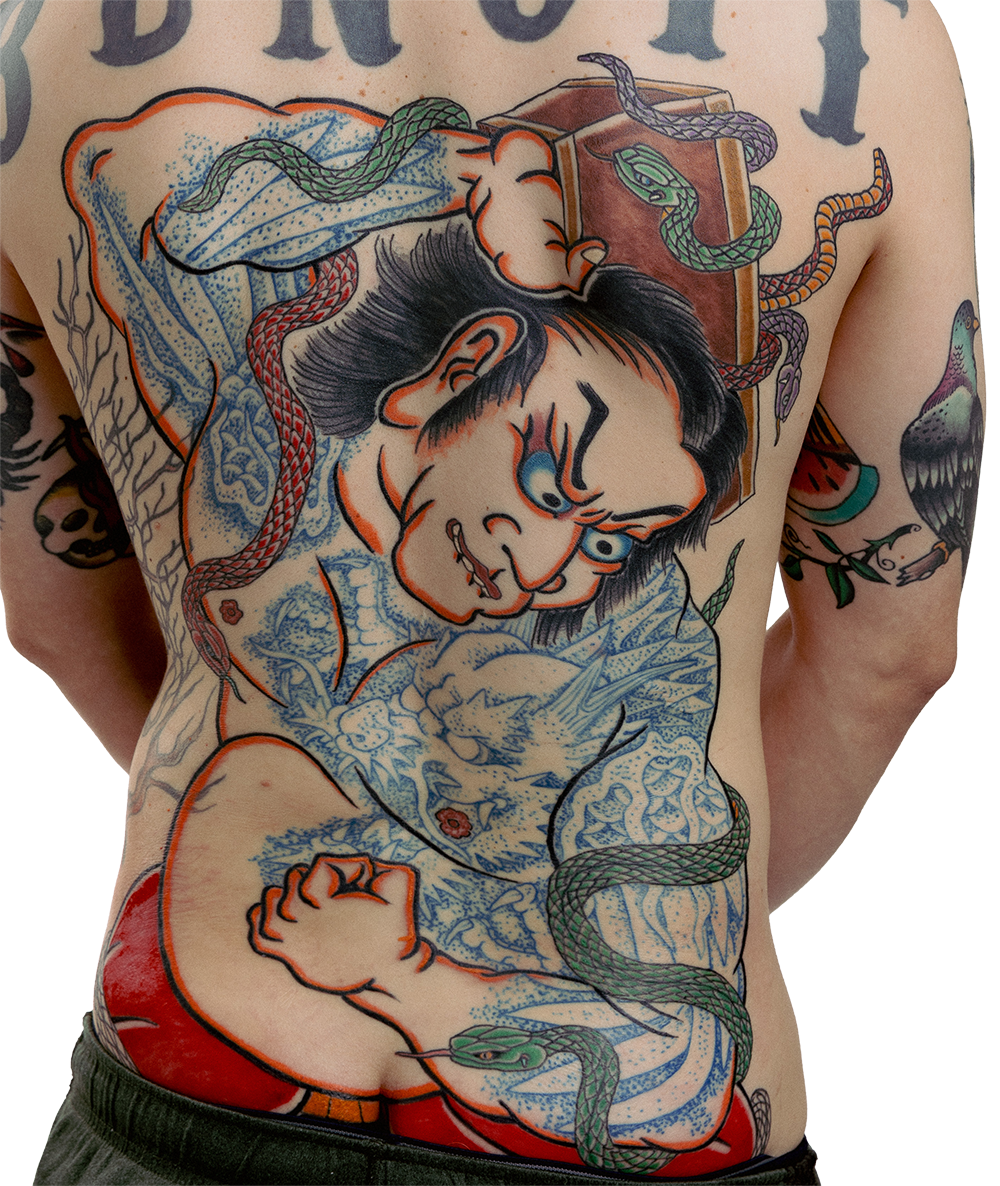
JG: I have such a limited understanding, as an outside observer, but my knowledge of Japanese tattooing… if I were to explain it to someone who didn’t know anything… Based on what I’ve overheard, I would say putting pieces together in my mind. Traditional Japanese tattooing is secret. It’s held discreetly to the point where you must be invited in or somehow earn your way in. Someone like Horiyoshi seems to break that tradition and wants to go worldwide; from my perspective as an outsider, he’s in rebellion, wanting to spread it out, a worldwide tattoo family. Someone like Shige explains himself as independent, not traditional; he has demonstrated to me that he stands alone independently and doesn’t want to have a tattoo family one way or the other.
R: Which is also very Japanese. Those are both such Japanese lines of thinking. You’re talking about very young people in that sense. Shige, for example, chose to have his sticker in English. (Points to Shige sticker from the Perseverance Exhibition) He loves his independence and yet his work is ultra traditional in many ways. But let me take it back… there’s truth to what you’re saying, but even before all of that… you have to look at Japan’s very complex relationship with the West. You have this nation that has Buddhism from India and culture coming from China and India mixing in with Japanese culture, percolating on this island nation becoming its own thing…with little stuff coming in from the Dutch and the Portuguese. Still, for the most part, they’re closed off. Then all of a sudden, the Black Ships come, and Japan opens to the West for trade…. And it’s like, “Ok, we don’t want to look barbaric to these Westerners, so we’re going to make tattooing illegal,” even though the very first written accounts of Japan, the Chinese said that people were tattooed on their face and arms, according to their rank, similar to what we could consider “tribal” or indigenous style. I assume it was more of a hunter/gatherer society back then, the Chinese brought the written language and the agriculture…
Anyhow... So, tattooing has always been there in one form or another. I read in a Samoan book about how the Lapita people, who would eventually become Samoans, some actually traveled North and became the Ainu. There may be some truth to that. This gets into carbon dating, but just considering aesthetics and lifestyle, the way their culture looks. I can see that happening.
Now, we’re talking about a country that has made tattooing illegal. Still, then wealthy Europeans are coming over. Throughout history, crown princes and royalty have come in saying, “We heard your tattoos are awesome. We want to get tattooed.” So then that’s where Horichiyo comes in, and it’s ironic that you mentioned two Yokohama tattooers because Yokohama is a very important city. After all, it’s a port, so all that culture comes in. And also goes out.
With tattooing, you always have to consider the source
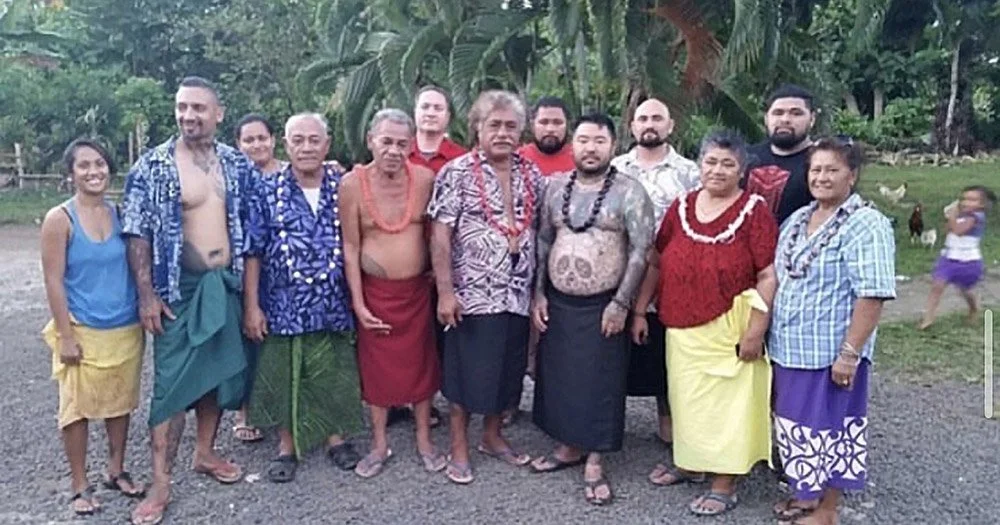
Taki with the Legendary Sulu’ape Aiga in Samoa, during the making of Tatau.
JG: Would you say that’s that first known Tattooer?
R: One of… one of many, he’s the one that we all know about. Regrettably, I don’t know too much more beyond that. But he tattooed a lot of royalty. So already there’s this relationship where tattooing is illegal for our people but not for your people, so there’s that, but fast forward now… look at Sailor Jerry… he had a long correspondence with Horihide. So when you say these Japanese are venturing out, they’re not the first. Technically, the “vibrating gun” was used since the 40s or 50s, post WWII, but ever since then, from the way I was told is that a lot of the Japanese tattooers are trying to get correspondence in America to get inks and machines and Americans want designs… so it was kinda working out. There’s that joke where Sailor Jerry invites Horihide to Hawaii, and right away Ed was like, hey, can you start my back and then I guess Sailor Jerry said to Ed, “nice knowing ya.” He kinda knew that was going to happen because that’s where Ed’s heart was. That totally predates Ed meeting Horiyoshi III or Shige even starting to tattoo. That was from the ‘70s, so that whole idea has been happening,
Another thing is that I am certainly guilty of this, too, as a Japanese American, and I feel that sometimes I’ve grown up apart from Japan. I still speak Japanese and have a good connection with Japan, but I’m still not fully Japanese. We tend to romanticize these things; they’re just people like everyone else. I remember Ed talked about when he went to Japan, and he’s assuming all these clients are going to know all this stuff about Japanese stuff, and they’re going to be serious, but they’re just like, “Oh hey, white guy can you get us guns?” I’ve had that same experience where I’ve seen great clients in every country. I’ve seen people in Japan who have no clue what they have tattooed on them and some very knowledgeable people. But I also see that here. You can kinda tell. One thing that’s so nice about specializing nowadays is that we can attract the right clients for the tattoos we do. I had a guy come in recently with a huge Kuniyoshi book; he brought it in with him; it was such a great book, and I had Molly order it from Amazon immediately. That’s the level of people we’re getting. Some people also just want something that represents “this or that” and let us figure it out, and that’s fine too. It’s essential to me that what I do has some sort of weight to it in the sense of history and culture. If I’m doing a samurai, I want it to be a specific samurai or convey something specific. It’s also art…so there’s very mixed emotions there.
I like to do whatever looks cool, but sometimes it’s not entirely Japanese, so I don’t want to do that. That’s something we all wrestle with to a certain degree. Suppose you look at contemporary Polynesian as opposed to traditional Tatau. In that case, there’s definitely a point where tattoos are considered to break from the point of tradition. Still, then it morphs into separate styles. At this point, there’s almost like a Euro-Japanese style… along with so many others. That whole idea of not wanting to be traditional is also very traditional. Everywhere. Look at any art history, especially in Japan.
You copy and copy your master to the point where Kuniyoshi and Yoshitoshi are indiscernible aside from the signature. Then, they break off and go their own route. Horiyoshi and Shige both have their own sense of bravado and showmanship; both of them, decades apart, went to Europe, took their shirt off, and showed their bodysuit. Brought a bunch of tattooed clients, and in a lot of ways, both wanted to show the best that they could. When we were invited to the National Conventions, one year I brought Horitomo and Shige, and the other year, I brought Shinji and Horitomo. The idea is that we will showcase the best Japan has to offer to this audience. There’s that desire to show your stuff. People bring 10 clients to show their bodysuits. At the end of the day, people are people. Some clients love showing it off, and that’s not necessarily a Western thing. There’s a long history of tattoo clubs and contests in Japan since the Edo period.
Things are a lot more open, Sanja Matsuri has become a tourist attraction. You can either like that or not; a lot of people like stuff until everyone else finds out about it. Everyone wants to be the last one in and close the door behind them. Every generation that goes to Japan seeking the authentic Japanese tattoo experience will feel like the generation before had a cooler one. Because I certainly did. In ‘98, I had an amazing experience. It was life-changing, but I can’t help but think, man…imagine being here in ‘73. I was just born, but still, it would have been pretty dope.
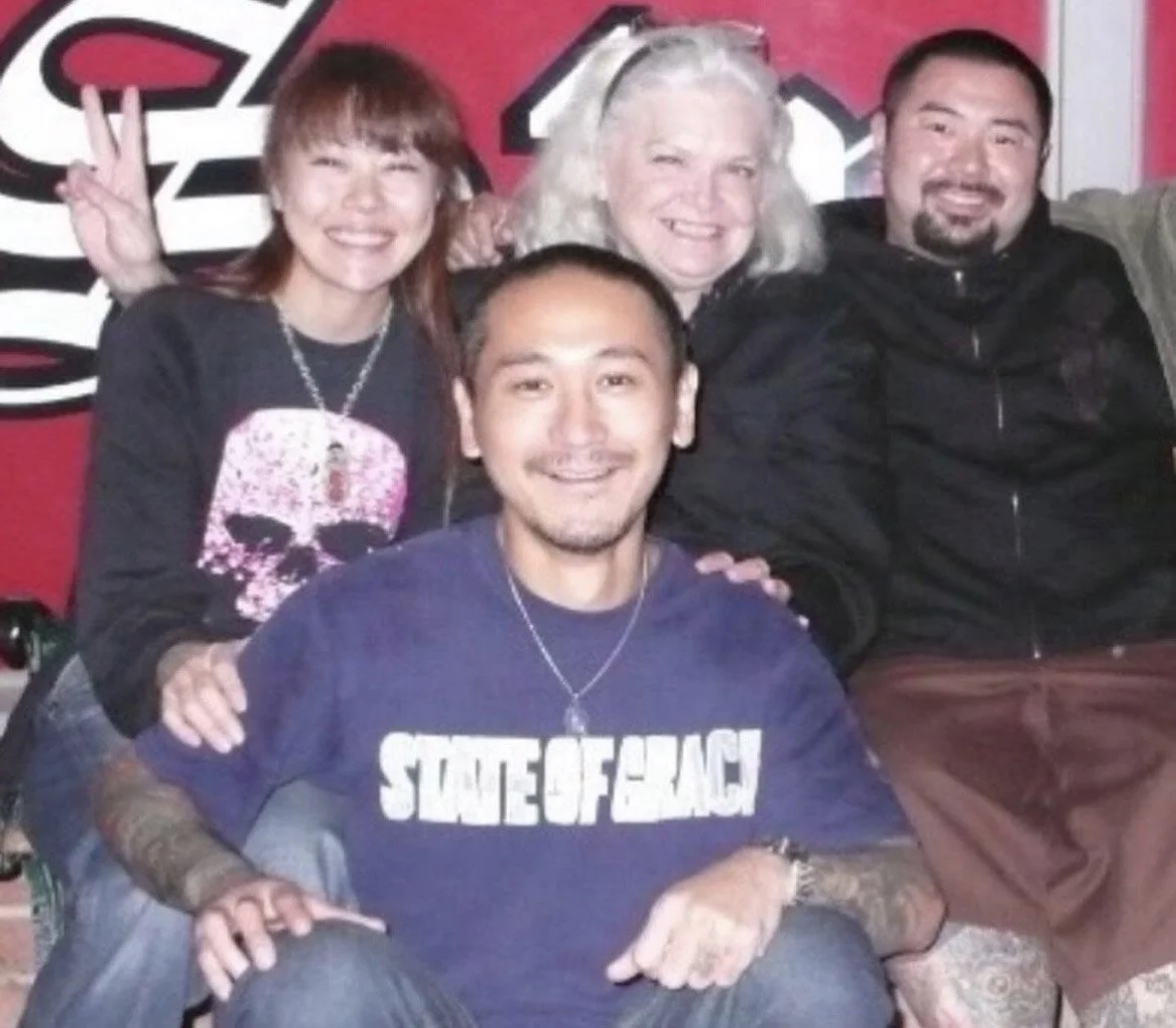
Shige and Chisato, Shanghai Kate, Taki
JG: I see people going to Japan now, and I feel like I had a better experience.
R: You might have, but especially now, one of the problems is that things are getting turned into social media experiences like, “Let’s all go to Tulum and take the perfect selfie!” But at the same time, there’s nothing wrong with going somewhere, having a good time, and taking a few photos. I’ve been a tourist and plan on continuing to be a tourist. That’s a much larger issue.
JG: Again observing… watching Chisato and Shige raise their daughter Ayaka. I met her when she was around 7, and every day, we’d be done working, and then we’d go to dinner. She would be done with school and studying, and it was now 8 at night, and she was still being questioned. She would go to school, and then after school, it was a private school until evening, homework, and then at the restaurant, she would be quizzed by her parents; it was such a driving.
R: That’s a normal existence for a lot of kids that age in Japan.
JG: I can’t imagine… it’s impossible for me to. Just hearing you talk, I see you come from a very educated, intelligent lineage. Your parents…
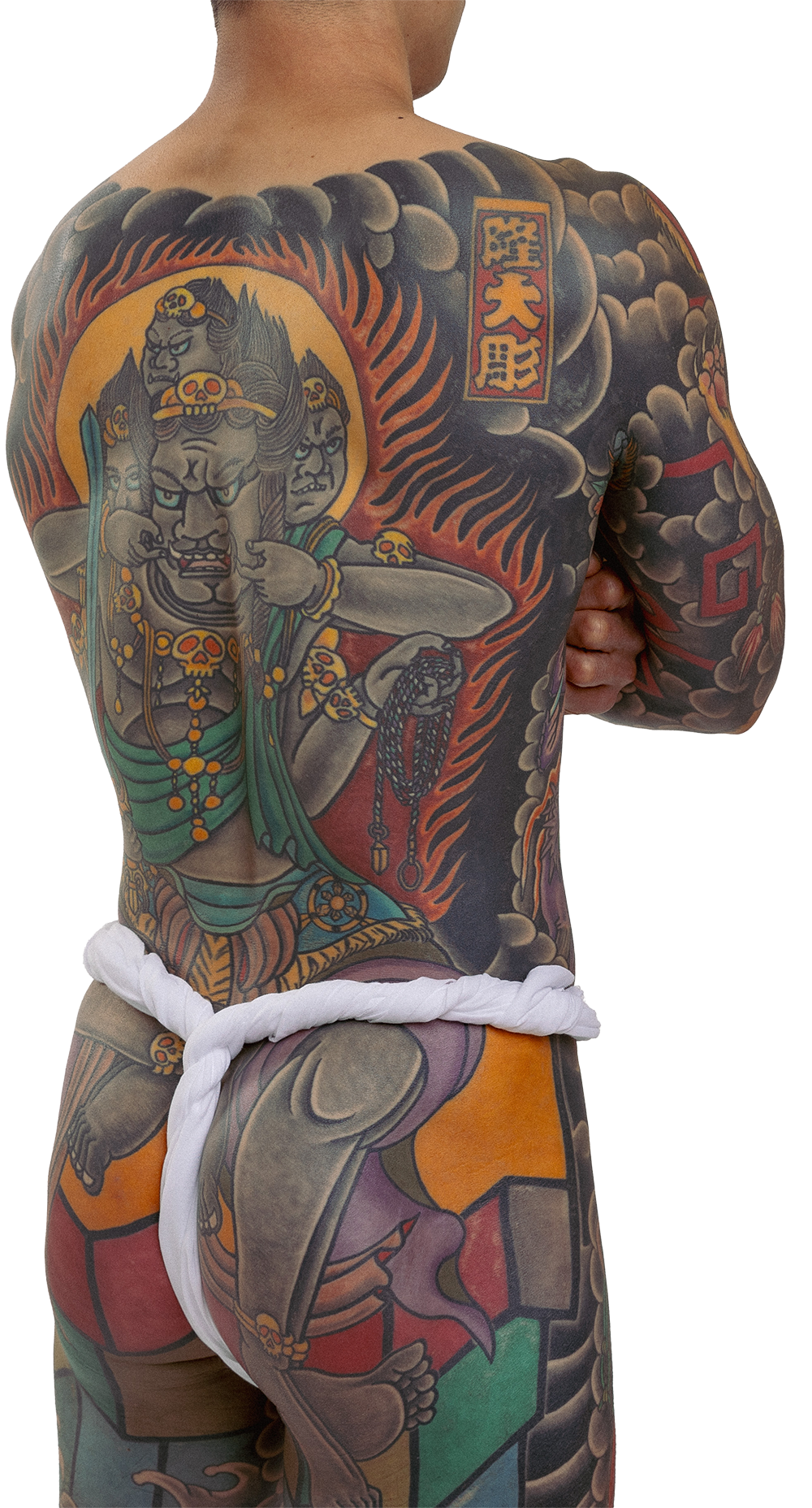
R: My father was a professor, and my mother went to Waseda University; my sister has a Ph.D. from the University of London and teaches at NYU, so…
JG: That’s your younger sister?
R: Yeah… she’s the prodigy. You can juxtapose being a young kid growing up in California… and all my friends are white kids out skateboarding. My Mom says, ‘Here you’ll do these Japanese lessons.” You know Kumon, the math thing? They have them all over now; it’s Japanese math exercises…basically more homework on top of homework. My Mom had those from Japan for me before they arrived in America. There’s cool stuff, too. I have the first 35 comics of Doraemon. I have the first 12 Dragon Balls before it was Dragon BallZ. I’m not into anime…I want to make that very clear….but I was just into it because I wanted to be Japanese. My written Japanese is terrible. I can write Hiragana and Katakana…but when I get to Kanji, it’s just basic…writing my name. As an adult, I think, man, I’m such an idiot. I should have learned that stuff. But when you’re a kid, no one wants to do more homework on top of homework… especially when your friends are camping and skateboarding. It’s like fuck this. It was a difficult thing for my parents because they were raised a certain way, and post-war Japanese were very strict. The whole country wanted to make up for WWII and work hard. My grandfather used to practice calligraphy….he would read the newspaper, use that paper to practice Fude, and then recycle that paper. No one thinks like that anymore. That level of conscientiousness. But in the 80s…so much technology, it’s hard to believe that half that country was rubble 30 years ago. There’s definitely a sense of working hard and determination that my parents instilled in my sister and me. Not just because they’re Japanese and my father’s a professor but because they really impressed upon us a need for education.
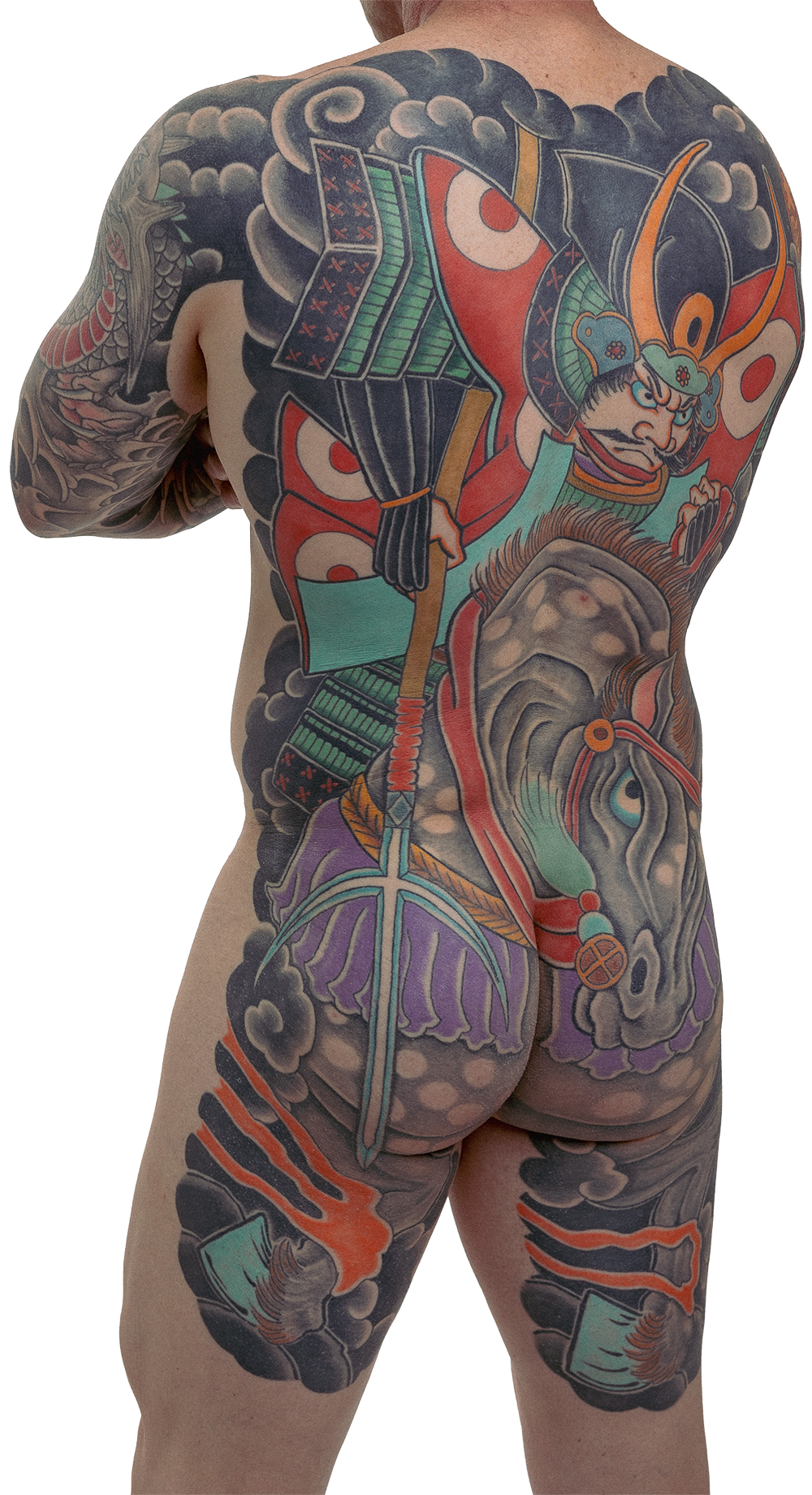
JG: You obviously appreciate that now, but not so much then?
R: Not at all.
JG: And your sister did?
R: My sister is just really smart; she’s good at everything. She is an incredibly talented writer. I kinda went the furthest direction away in becoming a tattoo artist, and yet, not so much as I look at it now. I’m doing the same things my Dad did in many ways but in a different field. You learn these things without realizing it. I’m grateful. The words “self-made” gets thrown out a lot, and I respect that, but I don’t think I was. I had two loving, educated parents and great teachers growing up. I’m an Eagle Scout. I had great scoutmasters and many great people in my life. And then getting into tattooing, Ed Hardy mentored me for 25 years… I had a lot of leadership in Japan. Some of which didn’t work out so well for me, but at the same time, I was being taught things by people…
JG: From my perspective, you were given the keys to the kingdom.
R: I think so.
JG: Being Japanese American… you already have the qualification.
R: Ed used to call me “The Bridge” after I wrote my first book Bushido. Ed always said that they’ll never accept his Gaijin ass. Ironically, in hindsight, we both agree that as a Japanese American, you’re never really fully accepted as Japanese, either. Still, he felt that I was one step closer and could get my foot in the door in a more real way.
JG: If you didn’t have your upbringing, too…
R: Also, that’s a lot of why I got recruited into the family. It was like, oh my god, we have a guy who was bi-lingual and could write shit? Boom. And look at that 10 years… look how much stuff we put out; we were such a productive family. I think there was a Moment when all of us were clicking. Back to your initial topic, is it good for Japanese tattooing? Well, I don’t know. In the sense that putting out more stuff is good? Then yes. In the sense of giving out secret information? Then possibly no. But I also think that cat was long out of the bag. I don’t feel the Japanese were keeping it secret….you can tell someone all this stuff, but it doesn’t mean they’ll be able to do it.
JG: There’s a human nature aspect to wanting to keep it a secret…but you want to tell your secrets to the people around you.
R: And our forebearers did it. Horichiyo, Horihide… all these tattooers that came way before us. Even Horikin and Horiyoshi got all their clients posing to do the Fellman book (The Japanese Tattoo) in the 80s and doing stuff for the Smithsonian… they were doing it. The doctor with the skins had Ed over there in the 70s. I think sometimes people, like right now people, want it more secretive, and everyone wants to go back to when we were in a more exclusive club.
JG: I do.
R: But in the big spectrum of history, we’re not. It’s been wide open from the people that came before us. I found my place. I think tattooing was something I could really believe in and love. And I think everyone needs to find that. When we talk about this weird group of people that all do this…hopefully, the common thread is that we all love tattoos. We can all argue about what tattoos should look like, who should get them… how much they should cost… people have a lot of time to discuss this shit on social media… but the point is that we’re all into this stuff. As a kid, I was awkward, and I didn’t really fit into stuff… and felt like I fit in here.
JG: You absolutely do.
R: This is something I want to bring up on that topic that you’re talking about my ethnicity and my culture and realizing that… I’m actually going to be starting a research project where I’m actually going to be doing interviews with Japanese Americans… because what I’ve found throughout my career is consistently, Japanese Americans seek me out. Japanese Americans love tattoos in a way that Japanese people don’t. You go to Japan; the people who get tattooed are a minority, and they’re usually from certain subgroups. Japanese Americans have this thing, and a lot of it has to do with growing up as an American, typically 4th-5th generation…a lot of them have never been to Japan and don’t speak a word of Japanese.
JG: I have so many clients like that.
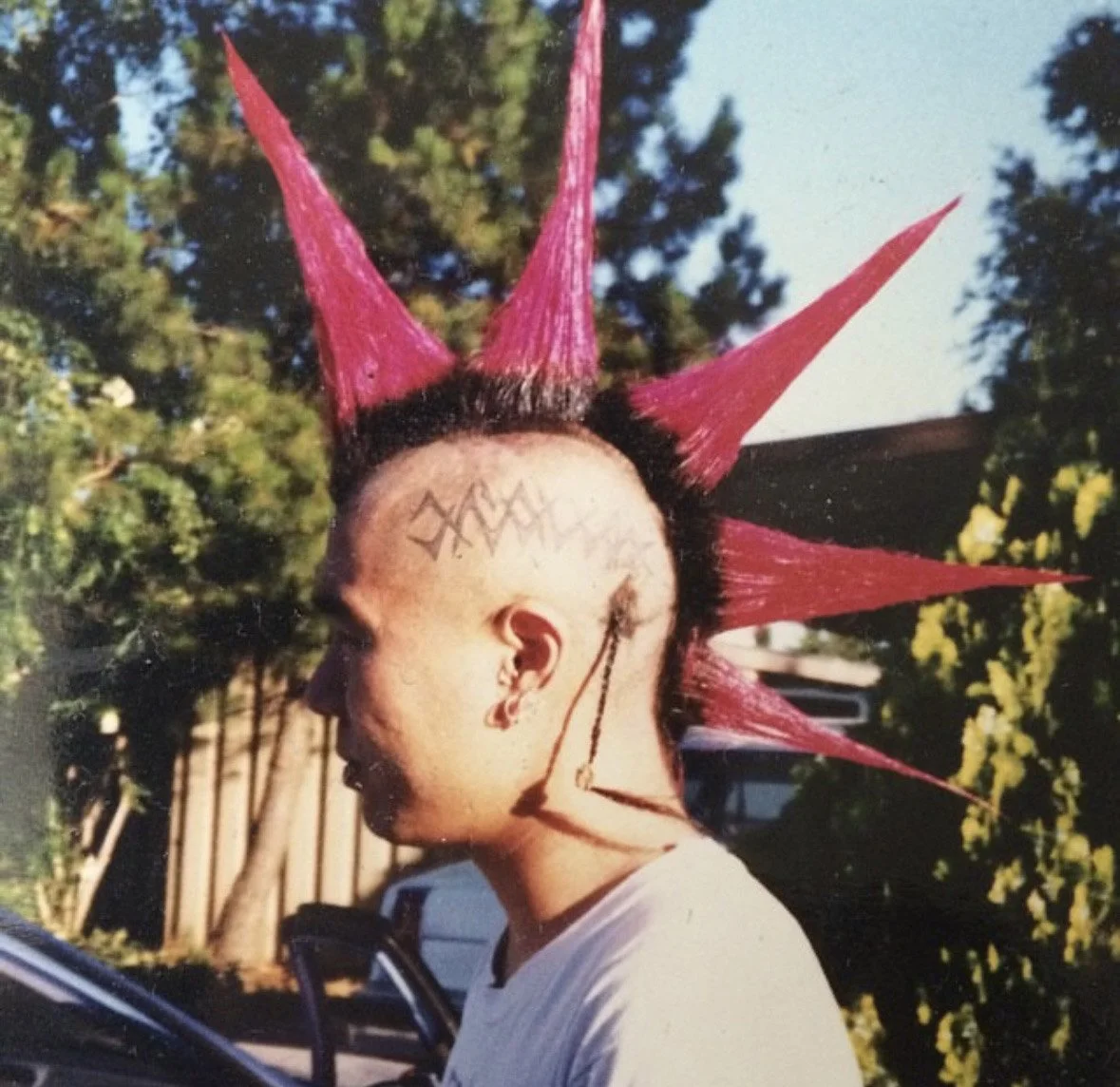
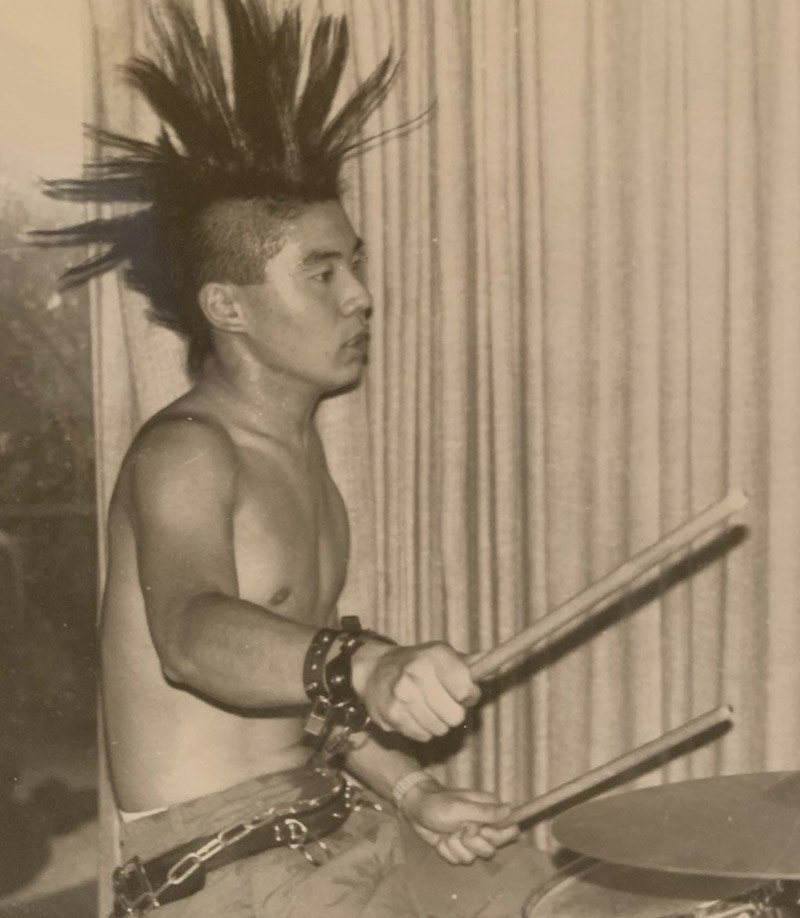
Mohawk and Tribal Head Tattoo, 1991
R: And yet, they’re always going to start with their Mon, and they see it as such a Japanese-and it is inherently Japanese
JG: Mon is?
R: A Mon, or Kamon, is a family crest, something not all families have, but if you have one it is a way to identify and express your lineage. I actually have both my crest from my father’s side and also my mother’s side tattooed on me.
As far as Japanese tattooing and who gets it? This is not for me to say— I don’t care who gets a Japanese tattoo, I don’t care who does a Japanese tattoo, but I want them done well and respectfully. Again, I’m not the tattoo police. That said, for me, including a lot of my clients and people who are Japanese Americans, there’s a special place in their hearts for it. Like the other day, we had a low-rider event here. Everyone around the world knows that Mexican-Americans invented low-riding, but there’s every race out there enjoying it. Japanese Americans are holding onto this connection, maybe they haven’t been to Japan, they don’t speak Japanese, and it’s something that is inherently Japanese that they can celebrate. And if that makes them feel better about themselves and unlocks a little piece of their history and identity, then that’s great.
On parallel courses, I see friends of mine like Sef Samatua who do Polynesian tattooing serving that same sort of need for their community, for their people to identify in. Sef also tattoos all kinds of people, so I think that’s something we’re all exploring; I’ve had people in Japan, not just tattooers, tell me, “But you’re not really Japanese.” It has bothered me, and I felt insecure about it. And you also get those people over here that say “where are you from?” in a negative manner. If you’re either Latino or Asian, then you can’t be an American. Whatever dude. I’m not trying to paint this negative thing because most people are nice. But I’ve had people in both countries be like, well, you’re not really from here, and I’m like, fuck you, dude, I’ll be wherever I want to be. Finally, after 25 years of tattooing, even with my work, even though I try 100% to make it authentic, I realize that what I’m doing, just based on who is doing it, is more like an American version. And I’m OK with that. A great example of that would be Brazilian jujitsu. It’s its own thing, and it’s fucking awesome. And we all know where it came from. You think of a chunk of people that all immigrated to the United States…if you look at the mass migration of Japanese here, they’ve been here for about 4 or 5 generations, so in some ways, they’ll be very Japanese. In other ways, they’ll be very American. And that’s OK.
JG: It’s its own unique culture.
R: We’re always looking for our sense of belonging, and my whole personal journey has been through tattooing. I will be 50, and I have been tattooing for 25 years. I started getting tattooed when I was 17; it’s been my biggest driving force aside from my family.
JG: The Japanese I know don’t get tattooed because of their parents. My friend Richard, who was born in Osaka and raised there, moved to Oregon and lived there for decades, and he’s in his fifties saying, “Man, I want a tattoo so bad, but I can’t until my Mom dies.’ And I’ve heard that a lot. If you could sum up two things…what was your mother’s biggest influence on you as a person or character? How could you sum up what she instilled in you that you depend on or consider who you are?
R: That’s a really difficult question… both my mother and father had such an influence…
JG: My next question was about your father…
R: OK, this is funny if we’re going to separate them. My Dad never spoke to me in Japanese; he had come over here, and it’s not cool to have an Asian accent in America. So, when teaching at UC Davis, he always spoke to me in English to work on his English. My mother was the one who took it upon herself to make sure I learned Japanese.
JG: Was that intentional teamwork on their part?
R: I’m not sure if it was intentional, but that’s what happened, and my Mom was the one who made sure to take me to museums. Tattoo art was probably the last thing she wanted me to do, but she did instill art in me. You should be drawing…that was my Mom. Both of them were really hard on me about working hard, being determined, being organized, and getting shit done. That was a collaborative effort. But separating the two… my Dad never spoke to me in Japanese. It’s actually pretty funny. But then, after teaching at UC Davis for 18 years, my Dad, when he went back to Kyoto, would have to ask students to help him with certain Kanji because he’d forgotten. My Dad was the weird professor when he returned because he was the American guy now; he wore flashy suits and looked great, but he wasn’t your typical Japanese professor anymore. Our family has always had that feeling like, fuck it. One time, we were in the airport, and there was a delay. My Dad went up and got us past this line and said, “You just got to do it sometimes.” And I knew what he meant.
JG: Because that’s not Japanese.
R: Yeah. He was very follow the rules, but break the rules. I look at it now as someone about to be 50, and I’m so much like my parents, unlike when you’re a teenager and you feel you’re not. And yet, I’m so much like my parents. I’m grateful for it. There is so much stuff I’ve been able to do that I’m proud of; it’s because of them. My desire to work hard is because of them. They always instilled that in us. You have to work harder than everyone else. Bust your ass.
JG: I will use Shige as a reference; I was raised by a self-taught artist, single Mom, painter, more of a craftsperson, anything creative. OCD about it. When she oil painted, it was nonstop; she made crepes, murals, and painted china; she had these creative facets. I always used the term artist; I only knew what an artist was after tattooing; I thought I was an artist, but I was just a replicator. Shige clearly told me he was a craftsman, not an artist. I understand what he meant. A craftsman is focused on learning the trade, getting good at it, precision, accuracy, and constantly improving for a better and better end product, no matter what. Artists identify everything outside of them as their environment and, therefore, understand themselves more and then reflect that understanding through an expression. An artist retells what they understand from the world with a message.
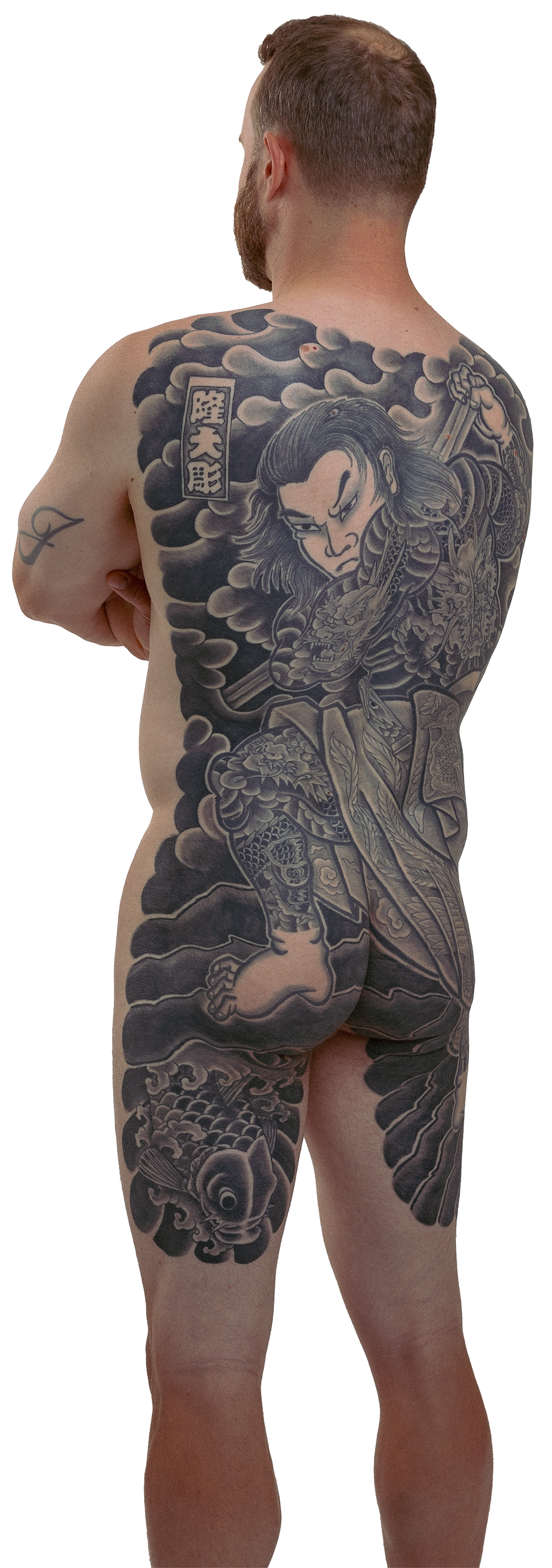
R: I agree with those definitions, but they are largely semantics and cultural differences. Many Japanese will shy away from the artist term, and most people will not look down on craftspeople. Still, they think, for whatever reason, an artist is a higher form. In Japan, it’s very clear that being a Shokunin and working with your hands is something to be proud of; many Japanese national living treasures work with their hands. For example, someone who makes swords with their hands. Fuck, dude, that’s such a high level of artistry. So I understand what you’re saying and what Shige says when he says that. I just talked to him, and he said I’ll be a craftsperson until I die. I see myself at a certain point when I feel like my hands and eyes aren’t good enough. I will stop, but he’s like, no, I have to do this forever. There’s a lot of pride. I say tattooer a lot because I don’t need the title artist. Sometimes I feel like it doesn’t fit, for example, two of the guys today… it’s just straight Kuniyoshi back pieces. I kind of went through this thing of 10 years trying to tattoo like my master, another 10 years trying to not tattoo like him, and now I’m really comfortable with my work style. In the last 5 years, I feel like I’ve hit my stride, and in that comfort, I’m noticing I love tattooing Kuniyoshi just as it is. I feel like Kuniyoshi is the quintessential tattooed, tattooers woodblock print artist. On top of that, I think there are a lot of times you’ll try to re-draw Kuniyoshi, and it’s like, how the fuck am I going to re-draw this? It’s perfect. What I realize is that idea of it being mine. As a beginner, I think there’s a lot of that “this is mine” and “I created it,” even though it references 50 million things that you didn’t create. And now, I don’t need credit for any of that. That’s a badass Kuniyoshi piece I did. I still get the credit for making it with my hands, spending 36 hours with clients, coaching them when they need it, getting coached when I need it, and putting that work in. It’s still hard to tattoo something in. If you look at Japanese tattooing, you think, why is Japanese tattooing so cool? And there are so many different answers, like the culture, the history of it…but on a base visual level, they’re going off woodblock prints. Their references were amazing. Many early woodblock print carvers and tattooers were probably the same people. They built this amazing bodysuit structure where it looks dope, even if the main design isn’t that good if you have the right background around it. I feel even more Japanese, traditional, and authentic when I do a Kuniyoshi piece. It’s not some weird interpretation I had. It’s like that print. When anyone sees it, they know what that is.
Don’t get me wrong, I love drawing stuff for clients, but I really love doing Kuniyoshi stuff straight up.
We have this vast pool of amazing Japanese artwork to draw from. I just like being a part of it. I look at the Samoan Tataus. To the uneducated viewer, they all look the same. Still, for the person tapping that in, freehanding that on there, and it’s so cool how every village, each master might add a little different thing cause they’re artists too. They’ve got their ego… I’m going to tattoo better than the next guy. Not in a bad way, in a competitive, fun kinda way.
JG: That’s how it evolves.
R: I remember how Horiyoshi had the whole Shuhari concept, where you build the world, you learn the world, and then you tear it down. Rinse repeat. He’s absolutely right, and that kind of mantra is for anybody creative. Look at Van Gogh, if you look at his early sketchbooks… perfect figure drawing. Like Da Vinci level figure drawing. We just saw the Sargent exhibit, where there’s a whole room of Sargent paintings in other people’s styles, so he would just look at something and repaint the same painting, and it just shows that level. I can’t see doing that; that’s such a devotion to your craft. Molly has been doing these Byzantine classes online, practicing religious imagery. It’s so cool. But for me, even doing the paintings for this magazine is hard because I don’t paint every day. And your hand isn’t trained when you don’t paint every day. But I’m only doing it to create this kind of thing. My interests are elsewhere; I’m more interested in doing more books and local events in my community, aside from my tattooing, which is obviously the prerequisite for drawings for tattoos. With Tomo, his drawings, his tattoos, a lot of the time he is painting Mon Mon Cats, and other stuff, everyone decides how they spend their time and what to put their time towards. Over the next few years, publishing will factor heavier, to the point where I’m going to start devoting a full day extra to that, starting next year, and rearranging my schedule. I think we’re multifaceted like that.
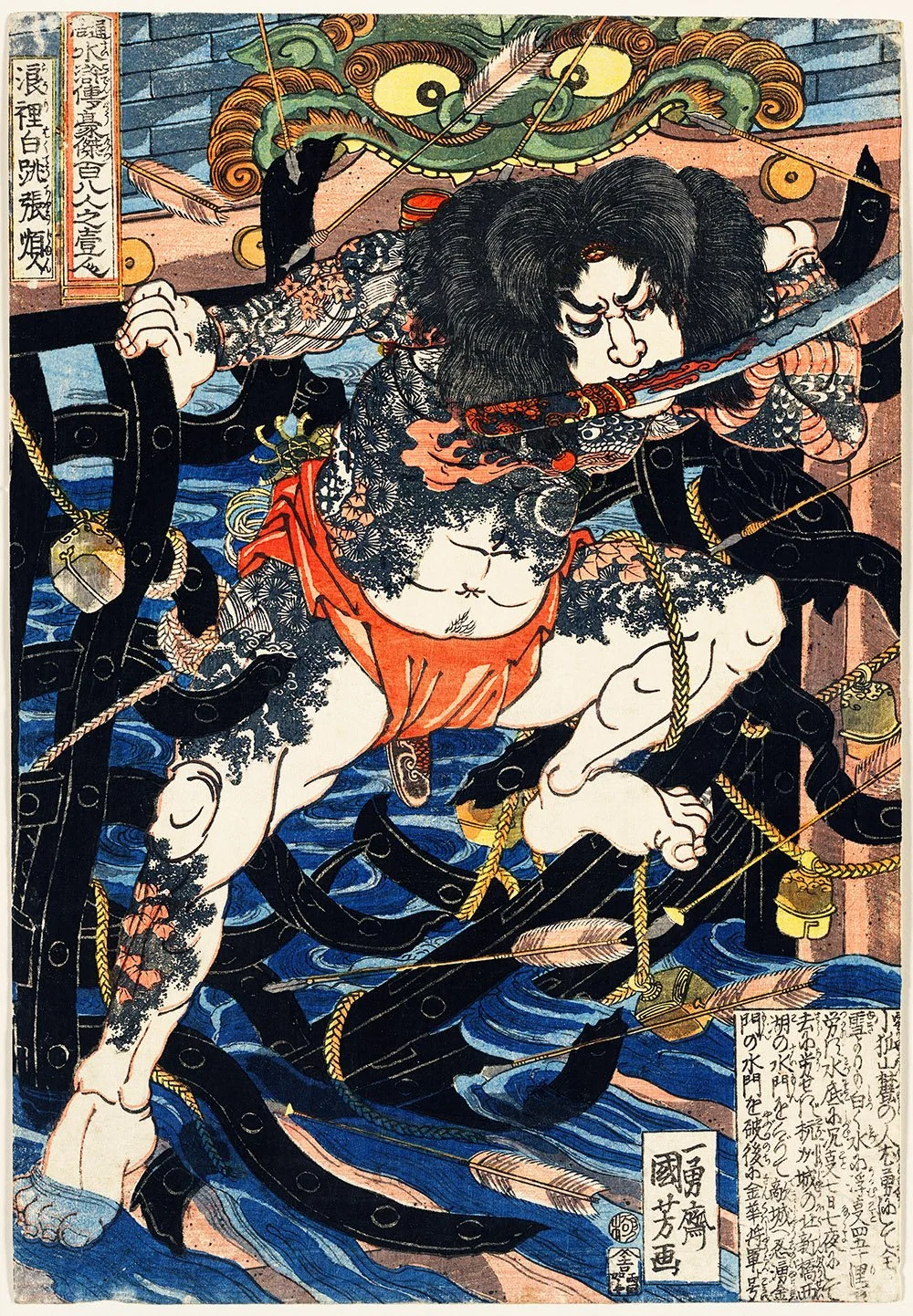
Utagawa Kuniyoshi (1753-1806)
Don’t get me wrong, I love drawing stuff for clients, but I really love doing Kuniyoshi stuff straight up.
JG: For sure. A lot of these questions are about that. You are a historian and a preservationist by preserving things and people in books
R: Amateur maybe… I don’t know if I’d say historian because there are people with Ph.D.s who have read thousands of volumes and gone and researched things. I think I’m contributing to the pool of tattoo history by documenting what I am. I also feel I’m a huge believer in oral history. A lot of tattooing does fall into that category where a lot of it isn’t properly written, and a lot of the older stuff was written by non-tattooers that would put a spin of judgment on it.
For the Leo Zulueta book, Leo lays out his book and writes his own thing. We’re just publishing it. He’s already a graphic designer. In the Pinky book, we pulled a lot of different things together. Ed’s flash collection that Pinky had gifted him, my photos with Pinky, my documentation of Pinky’s shop, and my recollections of him. We got a bunch of young artists to give us some information, too.
JG: You’re relaying what you understand and your connections with modern-day tattooing. The history goes back 20 or 30 years because those are your relationships, so you’re preserving that as this marker.
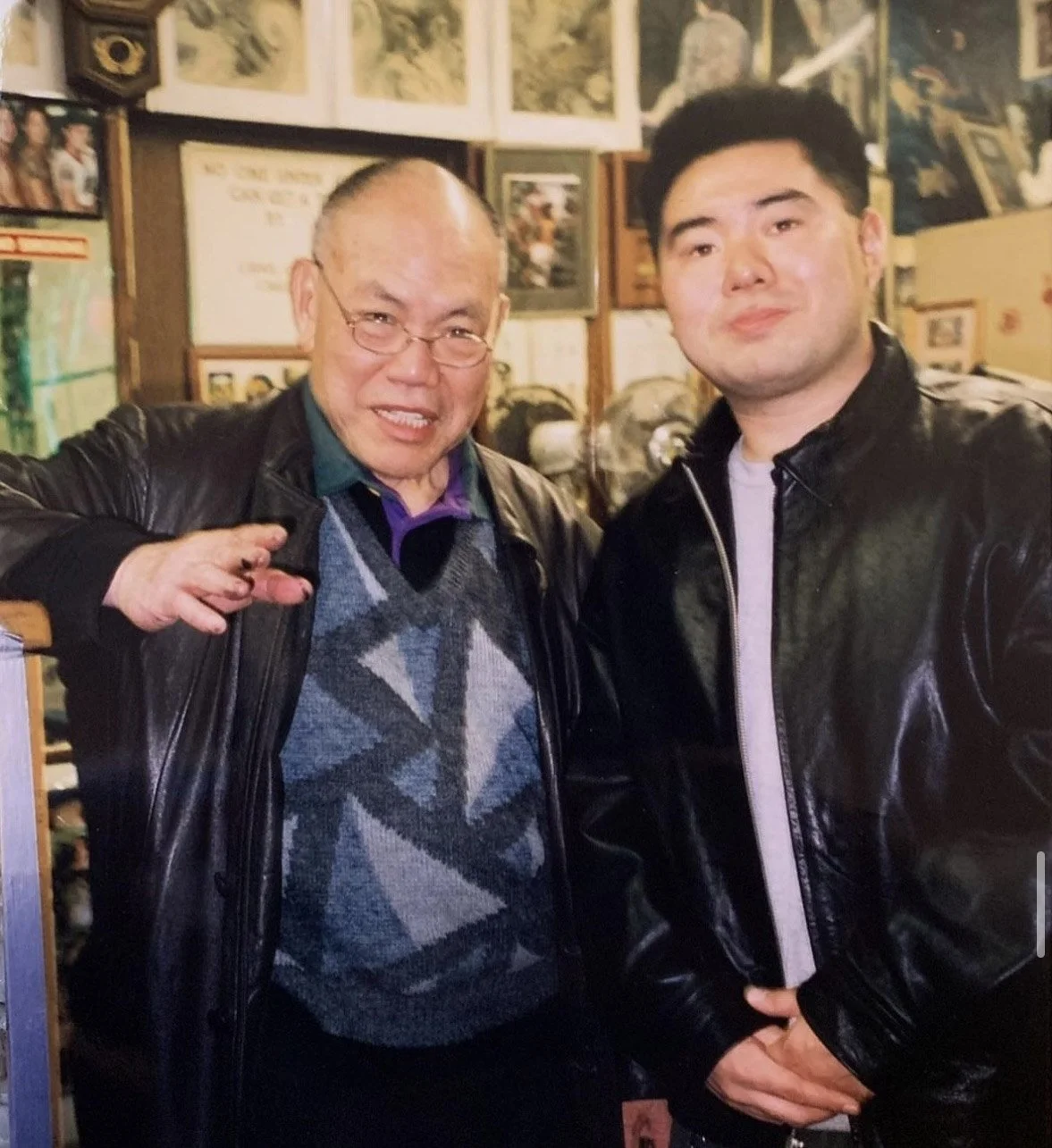
Taki with Pinky Yun
R: It’s funny you say that, though; a journalist recently mentioned to me that he wished he could have interviewed Ed Hardy, and I realized I’ve interviewed Ed, like, three times, and thinking back, man, I’ve interviewed Mike Malone, making the Bob Roberts book. Mike Malone tattooed at our shop for three days, we were just around so much cool shit back then we didn’t realize. I remember I went up to interview Lyle Tuttle. Ed had called him and was like Taki’s going to interview you! And I went up there… and that’s crazy. Now it’s like, holy shit.
JG: And you’ve kept all that stuff organized?
R: I have some. The Lyle Tuttle interview I gave to Andrew Stortz at Books Closed, I like what he does with his podcast. I am looking at two of Ed’s that I’d want to convert to digital and reprint.
JG: Do you have specific pointed intentions that are pointed at certain things?
R: I just do stuff. If you want to look at my production career with a critical eye, you could find a lot of flaws in it. But that’s back to that whole thing; like you mentioned, the problem I have with perfectionists is you can’t ever hit send or publish. Same with a tattoo; you need to accept it’s done at some point. In every book I’ve done, there are things I’d do differently now, but would I rather not have done the book? I’m sure I will feel stupid about some of that stuff later; everyone has things I’m sure they wish they could erase in their life.
JG: The difference between digital and social media stuff is everything is so temporary; podcasts are just talking. All talking.
R: It’s noise.
JG: Then they don’t even have to delete it. It just goes away. Books, not so much. Books stay. I see all my ridiculous videos on my YouTube from 15 years ago, and I can just delete them; no one published them for me. I can just take it away.
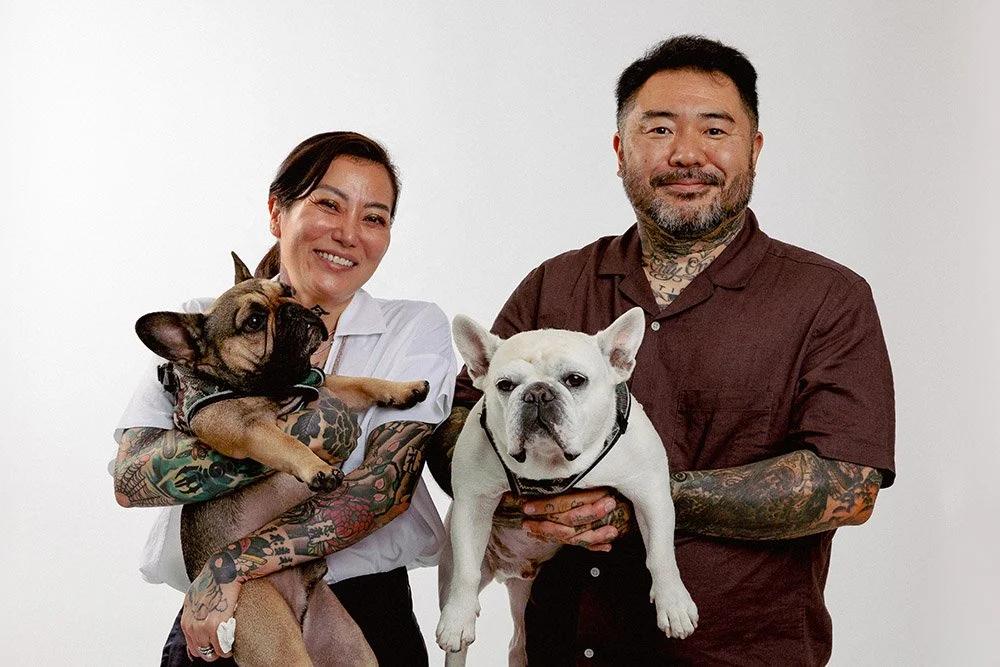
R: Some people like it; people love to argue about things that don’t matter. Like sports or the weather, anything online, people can be really mean about it. What I like about something like this, like a magazine, is that you’re in your own space. There are not 20 million people commenting. When I’m in the wilderness, I want to be in the wilderness. Enjoy the silence. That fresh air. Lately, I’ve been reading more; sometimes, when I’m trying to write, I need to read more and get my brain working in that dimension. I’ll start a book; if I don’t like it, I’ll move on. But it’s really nice when you get wrapped up in a book. I enjoy entertainment, a show or a movie, but it’s different; your brain isn’t functioning the same way with books to hold it in your hands. With Olinjär, one of the first things I noticed was the paper quality. It’s huge.
JG: That sounds Japanese to me, like a business card exchange.
R: Your price point and presentation look very Japanese to me. Undoubtedly, you and Laura are influenced by your experiences in Japan. For example, when you buy a little thing, sometimes the packaging is even more impressive than the thing you bought. There is a niceness to that. Social media is a disposable toilet bowl of stuff… don’t get me wrong, some memes are hella funny… I get it. But it’s like fast fashion. Sometimes, you get a product that’s just so nice you can use this thing forever. I can appreciate things that are well-made.
Did Shige show you that sword with the Dragon engraved on it? I lovingly say this because that’s my bro, but I get jealous of his antiques collection. He’s an astute collector, and I’m glad he’s doing it. Props to him. So he showed us this sword he bought. Fucking gorgeous. He’s taken me to look at swords… I haven’t bought one yet because I feel like there’s this certain amount of care, and you can’t just buy a sword… you have to care for one. I don’t know if I’m ready for that responsibility. And on another note, we go outdoors a lot, so we bought a Yeti cooler. Do you know how much that thing retains cold? It’s amazing. I remember thinking when I bought it this was the most expensive cooler I’d ever purchased. But I’ve never had a cooler work so well! In that sense, I want things to have that kind of quality. I remember doing the Bob Roberts booking with the slipcase and the gold embossing, and we wanted it to be a little precious and a little special.
JG: So we’ve touched on a lot of things; my last one really takes us back to what it always comes down to with every conversation between tattooers, which is, “With everything now, with how many people are doing it now, which is exponentially going out in all directions fast... When you start tattooing, you begin in ignorance; as you go, it weeds out people. The cream rises to the top. The best ones end up learning hard lessons and understanding much more. Hopefully... that’s where I’m just getting to now. I’m understanding more and falling in love with tattooing for real. When I went to Japan for the first time, 11 years in, I realized I knew nothing about tattooing and wanted to do “real” tattoos. Then, I spent the next 10 years fumbling through what I thought real tattooing looked like. Still, I needed to fully understand, not having guidance and being too proud to ask for it, trying to blend things into my style. And now I feel like fuck all that; if I’m going to do something Japanese, I want to look at Japanese block prints and replicate them. 15 years ago, I couldn’t draw art nouveau, not like Mucha, and I didn’t know anything about his life, so I didn’t deserve it. I won’t try to “draw” art nouveau out of honor for a master. Same thing with Japanese, find the picture you want, and I’ll tattoo it on you, or I’ll help you find a good image to represent what you like. Outside of that, I just enjoy drawing nature.
I remember in Shige’s seminar, he talked about the different types of tattooing and what it’s called; the kind that tells stories, folklore, religious, etc… my favorite is the type that focuses on nature, animals, plants, and flowers. I’m going that route because I can grow those flowers in my yard and look at birds and fish in my environment. I want to be influenced by how the Japanese masters did those things but still be able to be authentic; I’m not trying to tell the history of Japan because I don’t know it enough.
You are an incredibly influential person in this generation of tattooing. I knew that coming into this, and I’m realizing now I had little idea how influential you are and little idea how much you’ve actually done, so I’m really blown away now.
R: I don’t know if I agree with you, but thank you. I understand what you mean.
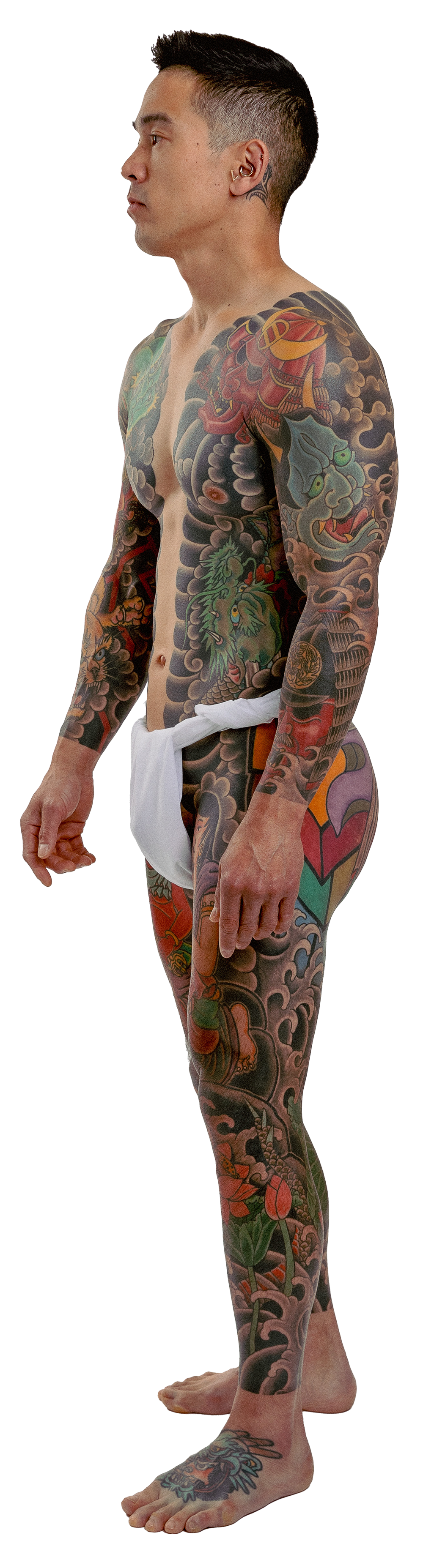
JG: But, I mean, who else is doing this? Ed Hardy’s done this level… but no one else has done this. I know Miki Vialetto puts out books and promotes artists, and he’s doing a lot also, but you’re….
R: I appreciate the compliment… but I’m just muddling through it, bro. You keep moving because you don’t know what else to do. At the end of it, I still love it; I still love tattooing. The spark of all of it. We’ve had books turn to profit…but I’m sure you’re finding out with Olinjär… there are easier ways to make money. You got to want to do it. The amount of time and organization, a lot of it isn’t that fun to do, same with putting on a convention, a lot of it is like bugging people about their health department crap… hey can you send this in… and I just got so tired of feeling like I’m just nagging all my friends. Granted, we had fun, and the same thing happened with the books, there’s always that moment of like, man, I’m so proud I put this out, but before that, there’s 12 moments of like, ahh, this fucking project… now there’s a delay at the shipping yard or ah, the prices just went up. And then there’s always the fear of losing money. But again, I don’t know what else to do, and it’s something I enjoy. I am aware I have a skill set and pattern that I am good at, and I do feel good about what I’m contributing.
JG: Does your brain go to the place where, 20 years of this world-renowned convention, that was an invitational, does your brain go to the place where every artist that worked your show, however, many times, every single year, for everyone that you had there, there was 1,000 more that were elevating and trying to get better so that maybe one day be the one could get there. Do you see that kind of influence?
R: I never thought about that. That’s a crazy thought. There are times when we’ve been criticized for the invites, but you can’t fit everyone in, but there have also been times when it’s valid, like you should work a little bit harder. Same thing with books; you sometimes think, fuck, I should have got this person. That’s something I’m coming to learn to accept; with any convention you throw, any book you put out, yeah, the people that got in are gonna be stoked. The people you can’t fit in might resent you for it, might be mad at you, and maybe you intentionally didn’t get in. Some perhaps it was just bad luck; stars didn’t align… but you just keep moving. I definitely focus on, like with Pinky, with Leo… there’s definitely stuff I want to put down for the historical record. Writing about Ed, for example, there’s some stuff that needs to be said about him as a person because he’s far more than just a great artist, he’s a great mentor, so that’s important to me. As I get older, I’m not trying to be a negative person, but we’re in a life-changing era…as you get older, you start to value that time and begin thinking about what you want to put out. One thing that’s happened is I’ve gotten excited about it again. There are artists I’ve seen grow up that have become next level in their work, and I want to put that out there. And I guess maybe it will inspire other people, but I suppose I just haven’t thought that far ahead. When we made the Shige book, we never thought we’d inspire people… we just wanted to express Shige… and it did inspire people and sold a shit ton of copies… but I don’t think when he tattoos, he feels that this tattoo will inspire people… but it will. He’s just trying to make a sick ass tattoo… we’re just trying to make a cool book. Ed would tell me that, like with Bushido, he would say to me that he’s hearing young tattooers using the words, albeit mispronounced, that you put in there. It’s not like I made that stuff up; we just published it in a format and a price point… I remember Garver telling me the year it came out that I think he got four of them for Christmas… because it was a $30 book; it was the perfect gift for that tattoo person in your life. The effect of how far that book went out, it still sells to this day, which is somewhat embarrassing for me considering I wrote it half a lifetime ago, but all the same… it’s out there. And I do feel like that book… it brought Colin (Colin Kenji Baker) to me because of one of my books and look at now, he is one of the best fucking tattooers in the world.
With tattooing, I was always encouraged to strive for excellence because you’re doing this for somebody else.
JG: You’re the huge influencer; the proof is there. Where I got to in tattooing. I got invited to Japan… I was going to Europe... I was featured in TAM and was asked if it was so important to me; why didn’t I go to Japan earlier? And it’s because I didn’t deserve it.
R: Sure. And I think humility is what is lacking; there’s a sense of entitlement… I get DM’s asking for apprenticeships… My parents always told me I must strive for excellence as a child. With tattooing, I was always encouraged to strive for excellence because you’re doing this for somebody else. Like, I’m not a participation trophy person, so for us to assemble an elite convention… Miki had the same idea, too… invite-only; let’s get a bunch of badasses… this will not be some dumb expo. So, having a quality standard is good, but it can very quickly turn into an exclusive gatekeeping club. The trick is for people to try to do these things reasonably. Everyone is all for inclusivity, but not at the expense of quality. I always wanted to have tebori and tatau in my show and make it a diverse group. Still, at the same time, I wasn’t going to let a hack in just because they fulfilled a quota. I realize with the current political state, this is probably a bad discussion to have, and I’m not trying to get into a political position in this interview, but I am just saying there are sides to this equation. For example, like with gatekeeping, sometimes it’s good because you keep out people who aren’t serious. I’ve definitely seen it in Japan, not with our family, but I’ve seen it with others where you have a corrupt master. So that can happen, but on the flip side, you have masters who teach their people really cool things and pass on traditions. Everything is relative. There are times when I wish we could have more people fit in our show, but you gotta draw the line somewhere, and I think it was better that we did it than not flawed as it might have been at times; I thought it was a pretty good show.
JG: At that time, I was getting tattooed in Japan; I was getting tattooed at Shige’s Studio; I think it was the year that Grime did the poster… so it had to be around 2011, and I’m in Japan working at Yellow Blaze. Thinking, man… I wish I could get into that show. I need to step it up. I wanted to earn it… I think Shige asked you… but I didn’t ask him to ask you.
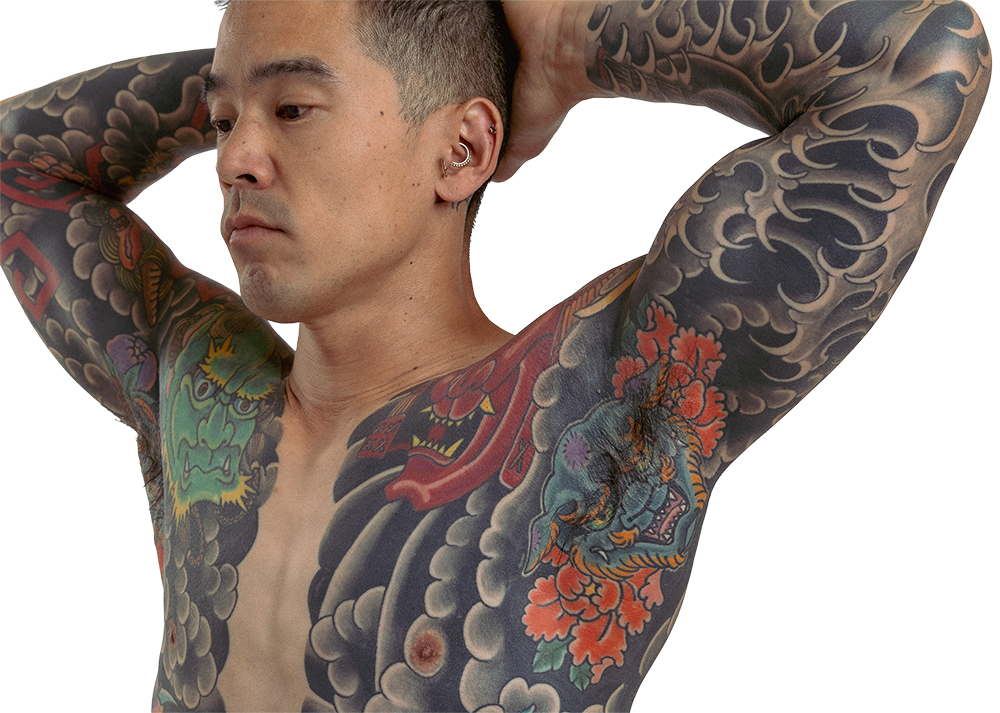
R: Shige loves you, dude, so that sounds about right. And I don’t want to be a show where just anyone can pay to have a booth… fuck that. That’s not what we’re about, either.
JG: There’s young tattooers now that are so bummed now that it’s over because they wish they could have got in that.
R: And I’m so grateful I got to hang out with Ed Hardy and Bob Roberts, and Mike Malone back in the day… but like Diane posted that thing about Art Fusion from Tattoo the Earth with Leo, Kandi, Mike, Ed, Bill and Jack….goddamn right? I commented on it because I was standing right there. Hardy was like, Hey Leo, you can handle this because it’s only black… and he was like, I’m just doing it because, with your name on it, it will be worth something…seeing these guys bantering… those are my gods… or the old photos of looking at the Yokohama tattoo club… like we’ll never be part of that… but I also think its kind of like everything has to come to an end. I didn’t want it to get stale. I think conventions do this thing where it’ll be hot for a while, but then everyone wants to go somewhere new. There was a point in my career where I was basically doing conventions as a springboard to visit cities like Rome; I went multiple times because Rome is fucking awesome. Italy and Japan are two of my favorite countries in the world. I think I’ve done Milan three times, Rome and Florence… there were definitely a lot more trips there because of people like Miki…friendships… and food. I think there should be a quality standard, but there will be gatekeeping. Sometimes people should be kept the fuck out of this industry, and sometimes it’s just petty whatever… we’re all human. You’ll get it, too, because you guys are now publishers. I would bemoan the fact that I couldn’t bring more people in, and my answer would be, well, when you do yours, you can do it; why is it my responsibility? I’m not the all-powerful Oz; you do it then.
That will be a question for you guys to answer as time passes. What’s our responsibility to the community as time goes on? If there is one. That’s up for debate.
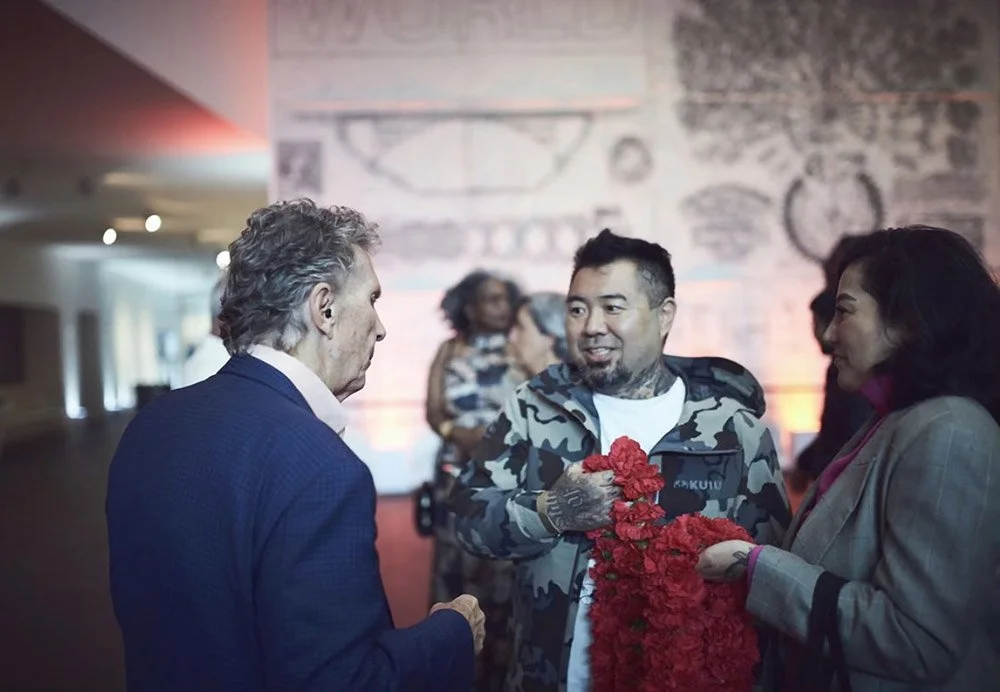
Reception for Ed Hardy Retrospective, 2019 - Ed Hardy, Taki and Molly Kitamura.
JG: And at first, we’d put anything in the magazine that held some genuine intentions, so it’s not always the most popular, won the most awards, or has done the craziest, biggest anything; it could be a grandma that has a little tattoo on her ankle if there’s a compelling story then we’d want to put it in there… but there are some things...
R: And there’s going to always be critics.
JG: And I appreciate that now more than I ever have before.
R: I’ve had people discussing Hardy’s impact… He was always a champion for diversity… promoting people from everywhere. But then there are people saying, but he’s this white dude… so what? And Ed was always respectful, he never acted entitled or like some fucking colonist. He was and always will be the most influential person for tattoo culture worldwide. They call him the Godfather of Modern Tattooing and that is such a perfect way to describe it. And I am so stoked to have worked with him on things, been mentored by him and carry on Hardy Marks with my wife. So fucking grateful for these opportunities and experiences. Not to sound like some weird gratitude junkie, but even sitting here with you guys… I feel fortunate. I have a lot of really cool stuff going on, and I get to spend time in a lot of cool ways and be artistically fulfilled, and it manages to pay my bills. That’s the American dream, right?
JG: Final question, I’m really thankful that you would take this time… but if you could finish this sentence… however you want… I know that’s kinda cheesy, but… if you could end this sentence….
“A good tattooer…”
R: “…loves tattooing.”
JG: Amazing!
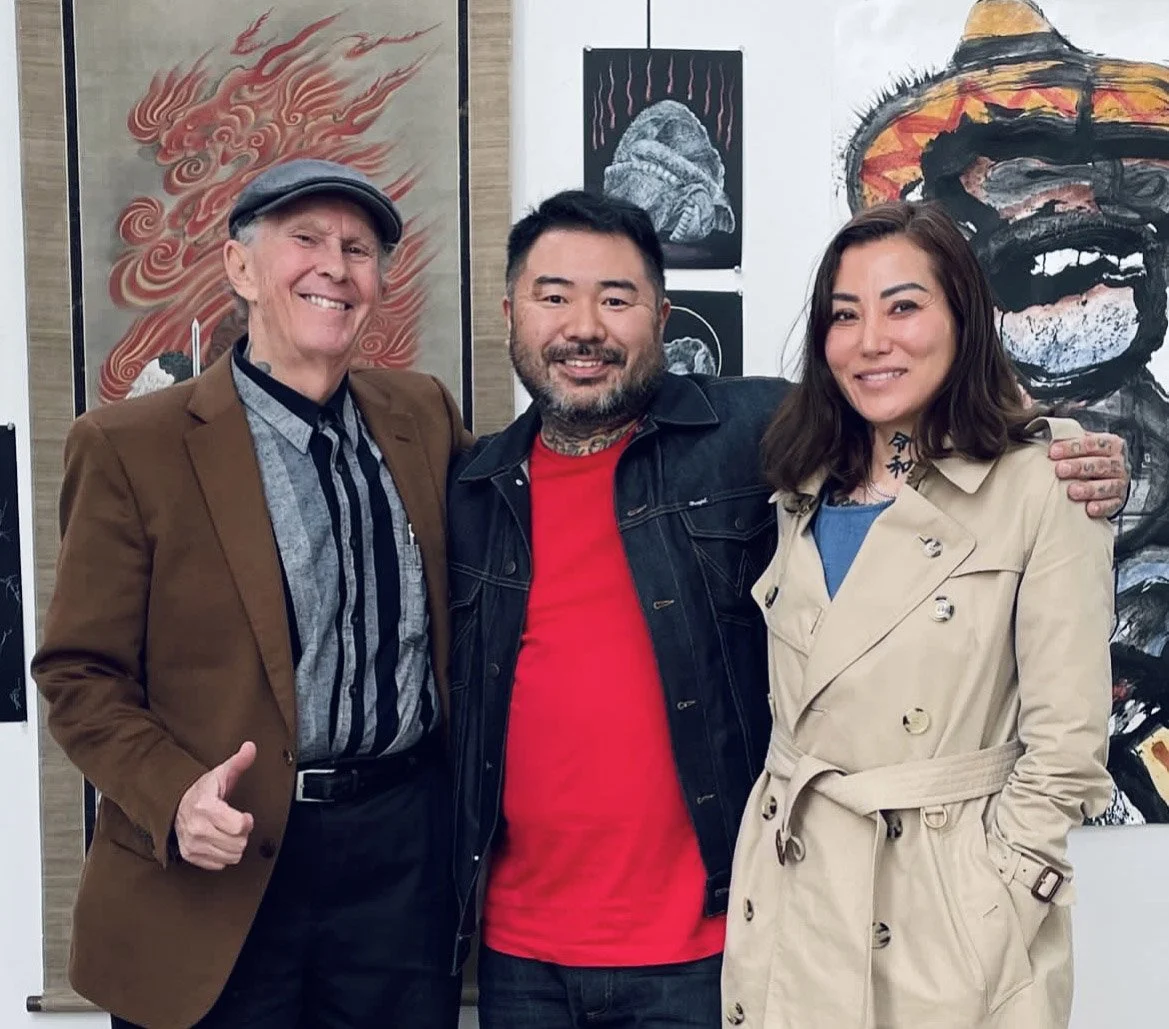
We want to congratulate Takahiro and Molly Kitamura on their new venture in continuing the legendary Hardy Marks Publications—the First Name in Tattoo Books, originally founded by Don Ed Hardy and Francesca Passalacqua in 1982.
Your commitment to preserving and promoting the authenticity and artistry of tattooing is inspiring and keeps the true spirit of the tattoo culture alive. We wish you many years of continued success in the publishing world.
Thank you for your unwavering dedication,
Jeff and Laura
hardymarks.com
@hardymarkspublications